The Art of Building on a Sloping Block in Brisbane: What Hillside Sites Really Demand
By Manny, Co-founder & Principal Architect, Quorum Studios — Newstead, Brisbane
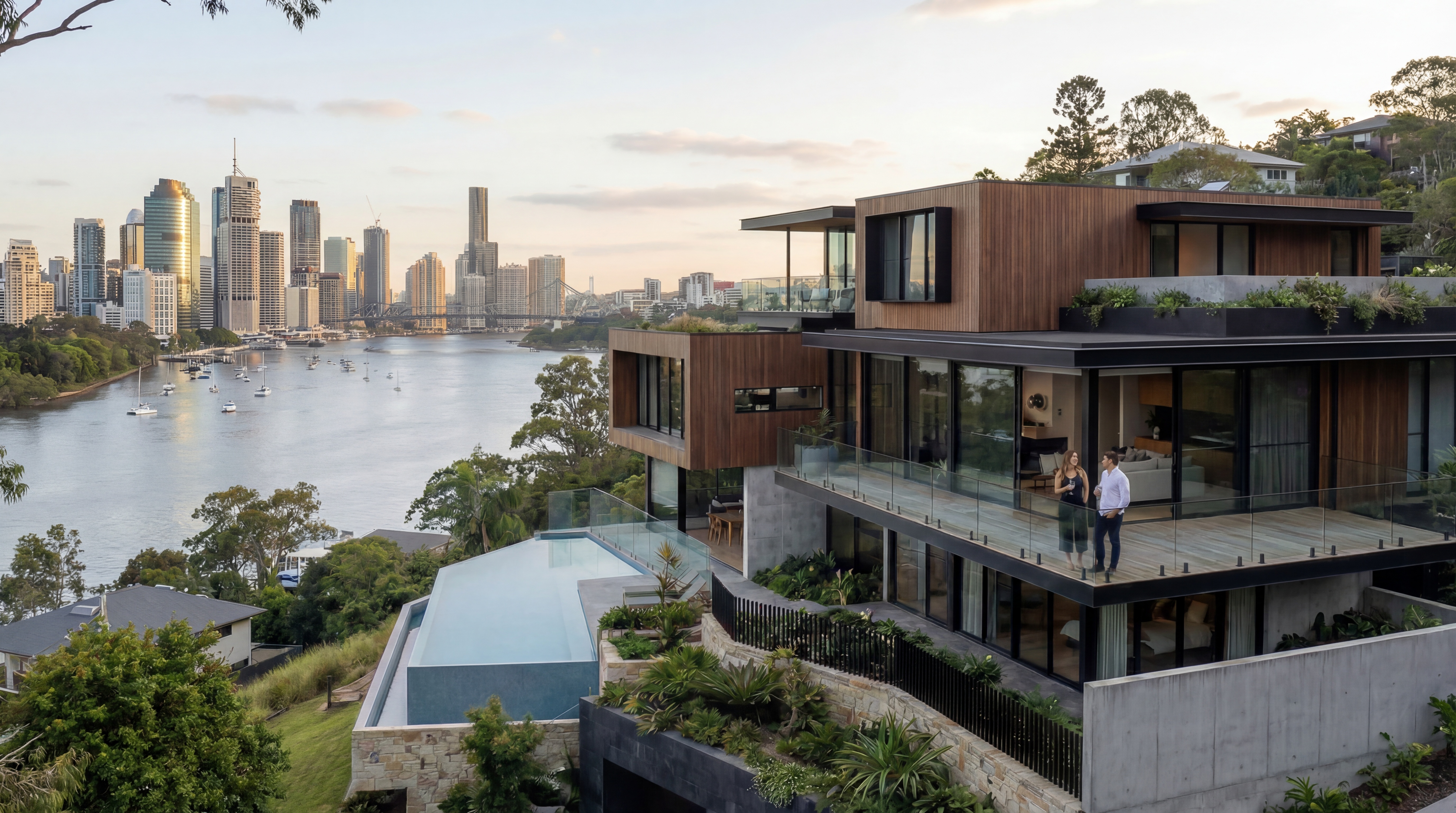
Brisbane's topography is one of its defining characteristics — and for residential architects in Brisbane, it is also one of the most intellectually engaging problems the city presents. From the elevated enclaves of Paddington and Red Hill to the steep hillside streets of Hamilton, and the large character blocks of Ascot, sloping sites demand a level of design and engineering rigour that flat suburban land simply does not require. The challenge is real. But so is the opportunity.
We are a boutique architecture studio based in Newstead, and we work on hillside projects regularly across Brisbane's prestige inner suburbs. This guide is written for homeowners thinking seriously about building or renovating on a sloping block — not a generic overview, but a practical lens on what these sites demand, what the planning rules actually allow, and how to get the best possible result from difficult ground.
“A sloping block is not an obstacle. In the right hands, it is an opportunity to create something that a flat site could never produce.”
Why Brisbane's Hillside Suburbs Produce the City's Best Architecture
Brisbane's undulating terrain has shaped the character of its most sought-after residential suburbs. The same geological conditions that make Hamilton Hill dramatic also make it one of the most architecturally interesting residential contexts in the country. The same is true of Paddington, Red Hill, Bardon, and the riverfront slopes of New Farm. These suburbs attract clients who understand that the construction premium on a steep site buys something that no flat block can replicate: elevation, outlook, orientation, and a sense of being embedded in the landscape rather than simply placed upon it.
Brisbane's subtropical climate adds both complexity and opportunity to hillside design. With annual rainfall averaging 1,200mm and summer temperatures regularly exceeding 30°C, a well-positioned hillside home can achieve passive cooling performance — through natural ventilation, cross-breezes, and strategic shading — that would be far more difficult to engineer on a flat site. As a passive design architect in Brisbane working regularly on steep terrain, we treat the topography not as a constraint to be engineered around but as a climate-performance asset to be designed with.
For those in Hamilton, Ascot, Paddington, and the other inner suburbs where our work is concentrated, the hillside condition is part of what makes the address desirable. The view from a well-positioned hillside home in Hamilton — Brisbane River, city skyline, the full sweep of the basin — is not achievable on any amount of flat land anywhere near the CBD.
Understanding Brisbane City Council's Storey Calculation Rules for Sloping Sites
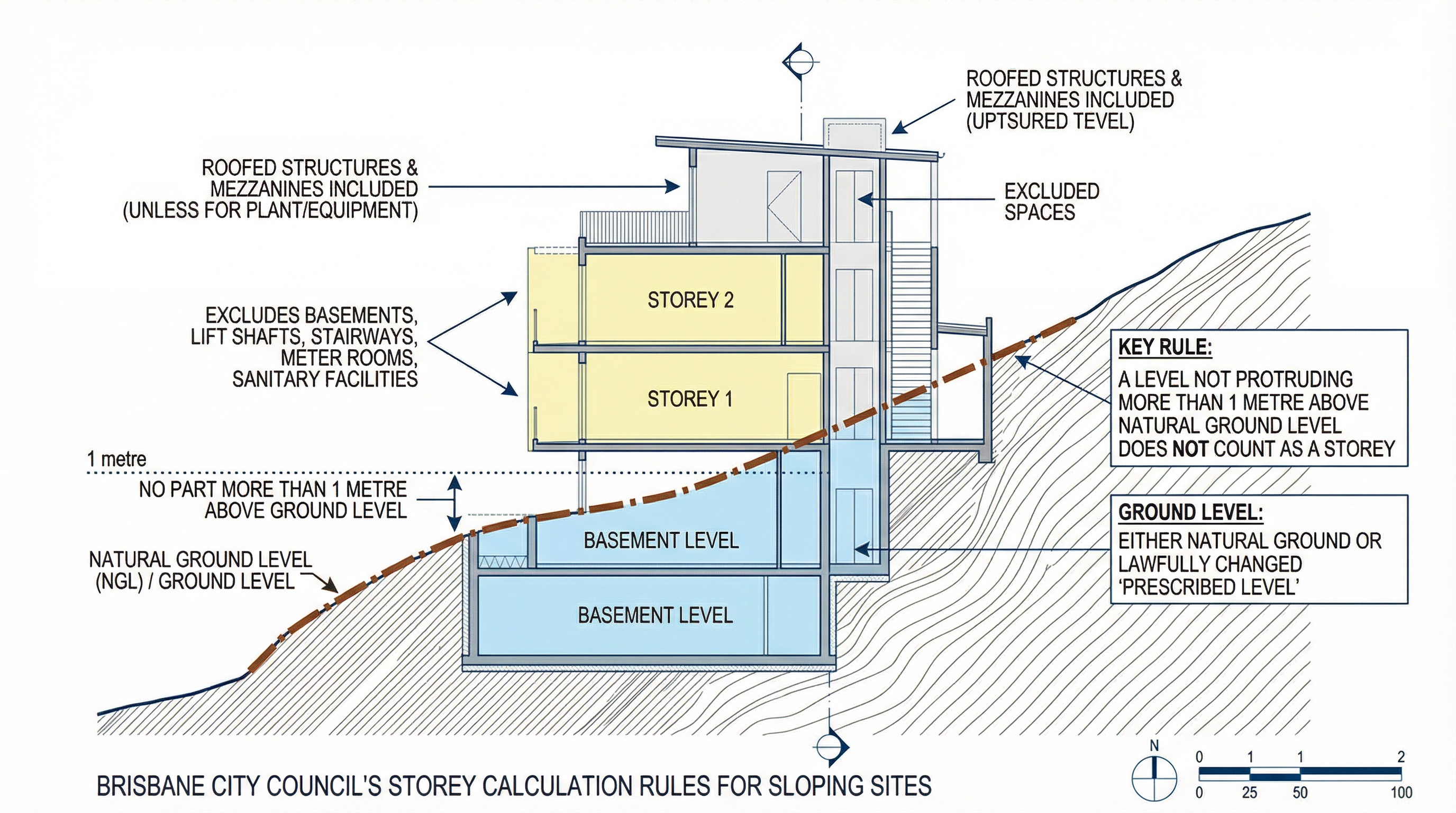
One of the most significant planning advantages available on a sloping block in Brisbane is a provision most homeowners — and many building designers — are not fully aware of. Under Brisbane City Plan 2014, which adopts the definitions of "storey" and "basement" from the Planning Regulation 2017, a level that does not protrude more than 1 metre above natural ground level does not count as a storey. This is the single most important planning rule to understand when designing on a steep Brisbane site.
To be precise: under the Planning Regulation 2017, a "basement" is defined as a space between a floor level and the floor level immediately below it, where no part of that space is more than 1 metre above ground level. A "storey" excludes basements with ceilings not more than 1 metre above ground level. It also excludes spaces containing only lift shafts, stairways, or meter rooms, and spaces containing only bathrooms, laundries, or other sanitary facilities. Mezzanines and roofed structures on rooftops are included in storey calculations, unless they accommodate only building plant and equipment.
In practical terms, this means a building on a steeply sloping block in Brisbane can have significantly more levels than a standard two-storey dwelling while remaining technically compliant with height and storey limits — if designed with these definitions in mind. A building with six levels might, when designed correctly, have only two countable storeys: by using the basement definition for levels cut into the hillside, stepping upper floors to avoid any single three-storey cross-section, and treating rooftop terraces as non-storey outdoor space. As an experienced sloping block architect in Brisbane, understanding how to apply these definitions to a specific site is one of the most valuable things we bring to a brief before a single line is drawn.
It is equally important to understand how Brisbane City Council defines "ground level" itself. The term "natural ground level" (NGL) is not the official planning term — Council uses "ground level," which is either the level of natural ground, or, where the level has been lawfully changed, the level as changed (known as the "prescribed level"). This distinction can meaningfully affect how the storey rule is applied across a site that has been previously cut or filled, and it is one of the first questions a luxury home architect in Brisbane working on a hillside site should be asking about any specific address.
“The 1-metre rule is not a loophole — it is a considered planning provision designed to allow hillside sites to be developed intelligently. Understanding it is part of what separates experienced hillside design from guesswork.”
The Engineering Requirements of Hillside Construction
Retaining Walls, Structural Complexity, and Cost
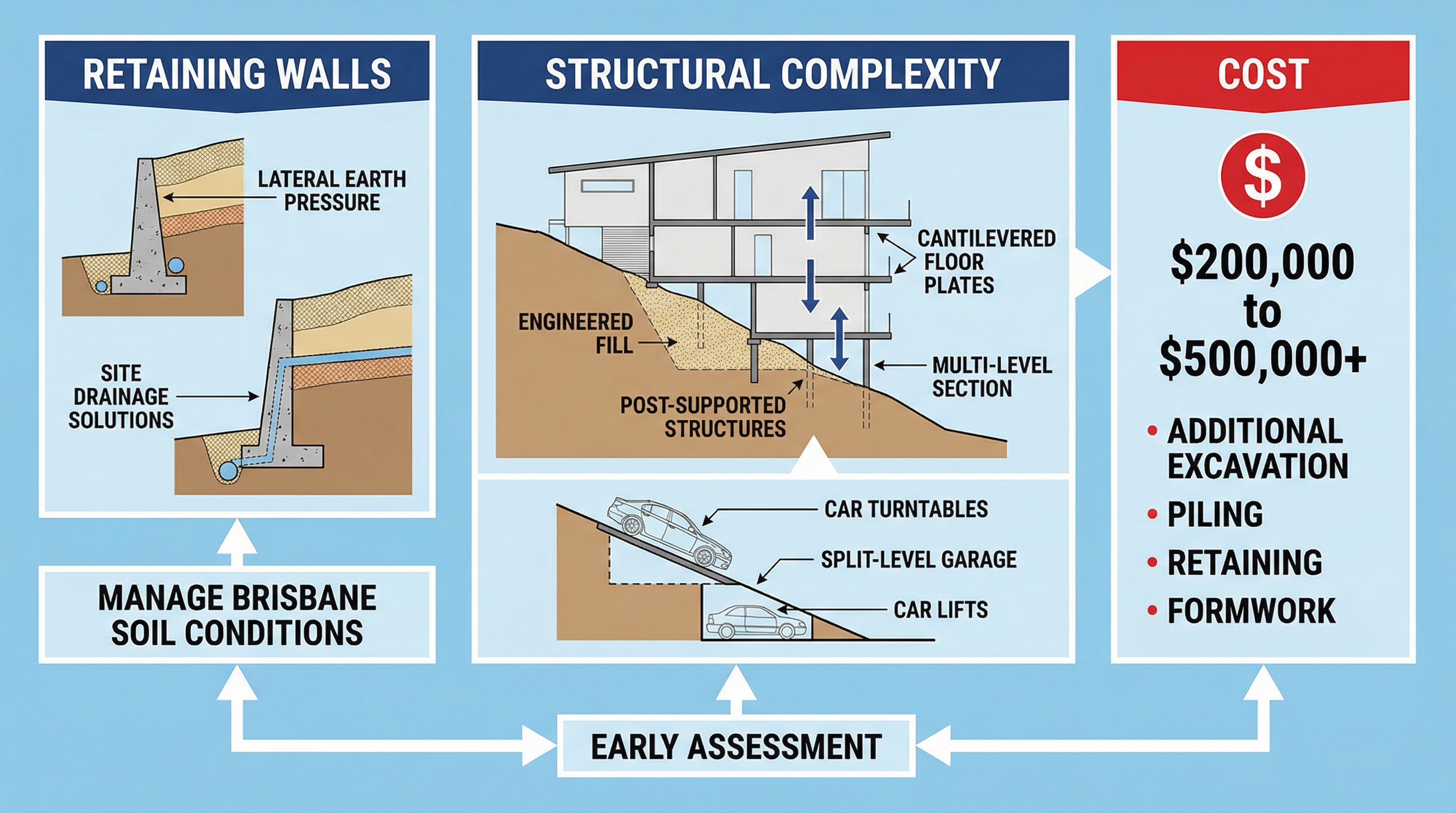
Building on a sloping block inBrisbane requires engineering solutions that go well beyond standardresidential construction. Retaining walls are an inevitable element of mosthillside developments, designed and detailed by structural engineers to managelateral earth pressures, drainage, and Brisbane's specific soil conditions. Onsteeper sites — where grade changes of five, eight, or ten metres are common insuburbs like Hamilton Hill — the structural response typically involves acombination of engineered fill, retained levels, cantilevered or post-supportedfloor plates, and a multi-level section that distributes the building programacross the grade rather than fighting it.
The construction cost premium on steep Brisbane sites isreal and should be factored in from the earliest stage of any project.Additional excavation, retaining, piling, and formwork can add $200,000 to$500,000 or more to a comparable project on flat land — sometimes significantlymore on extreme grades. For clients comparing a hillside brief to ahypothetical flat-site alternative, this cost differential needs to be on thetable at the very beginning of the conversation, not discovered during documentation.A high-end residential architect in Brisbane working on these sites knows tocommission a structural and geotechnical assessment before any design workcommences.
The driveway and garage are frequently the most technicallydemanding element of a steep-site brief — more so than the house itself.Manoeuvring a prestige vehicle safely on a steeply graded site with a narrowfrontage requires early design attention, and it is one of the problems thatexperienced hillside architects in Brisbane have developed specific responsesto: car turntables, split-level garages with internal vehicle movement, carlifts, and dedicated turning forecourts are all commonly employed. Theseelements must be resolved at concept stage — they cannot be detailed inlate-stage documentation without compromising the rest of the design.
Waterproofing, Moisture, and Durability
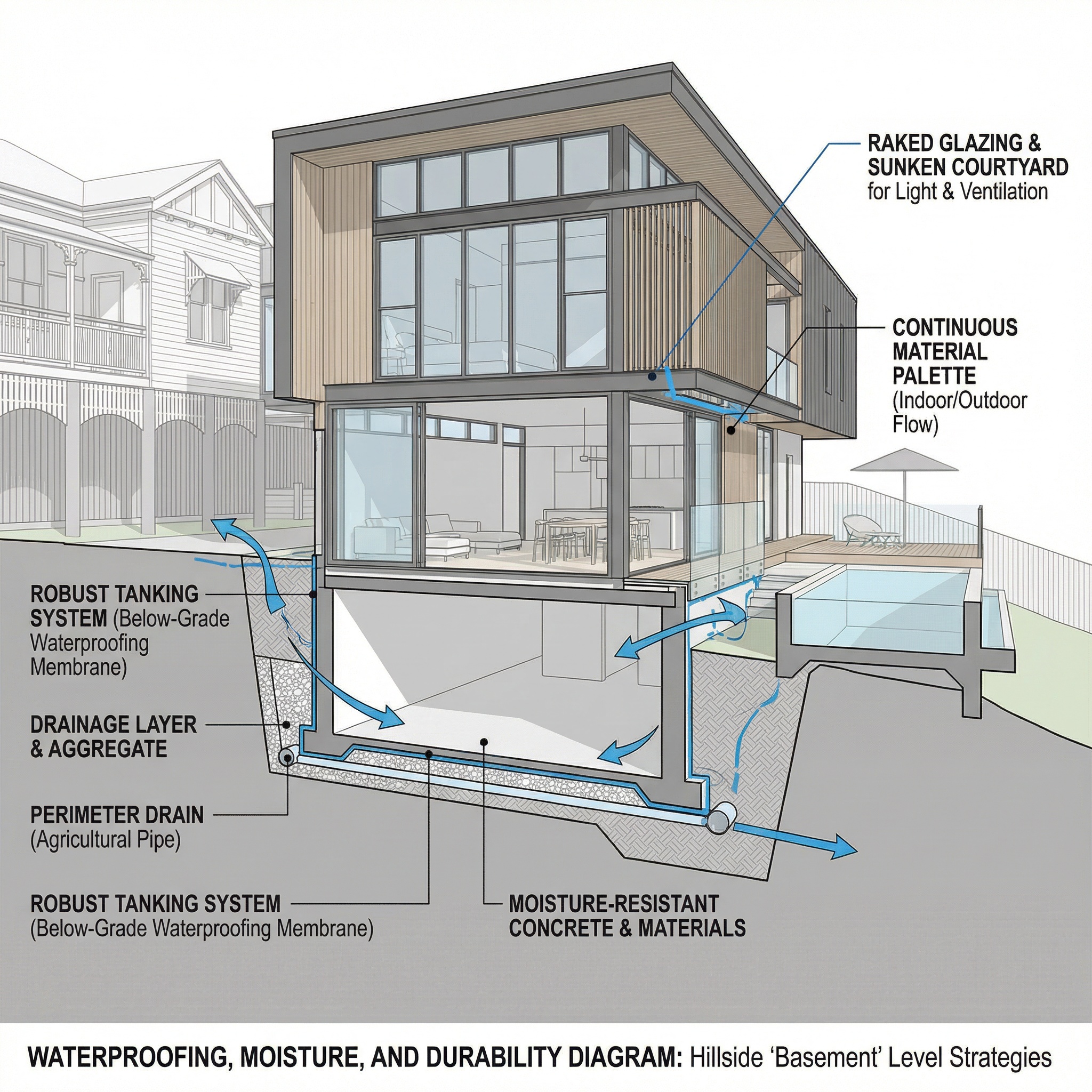
For levels cut into a hillside — what Brisbane City Plan refers to as "basement" levels in the storey calculation context — moisture management is a design imperative, not an afterthought. Brisbane's subtropical rainfall regime means that below-grade and cut-in construction must be designed with robust tanking systems, drainage layers, and moisture-resistant materials from the outset. This is particularly important for living spaces at the cut-in level, where the temptation to treat these rooms as inherently dark or cave-like should be resisted. With careful design — sunken courtyards, raked glazing, strategic skylights, and continuous material palettes flowing from inside to outside — even a deeply cut-in level can feel connected, light-filled, and genuinely liveable.
Maximising Views, Light, and Natural Ventilation on Brisbane's Hillside Sites
The View Corridor Philosophy
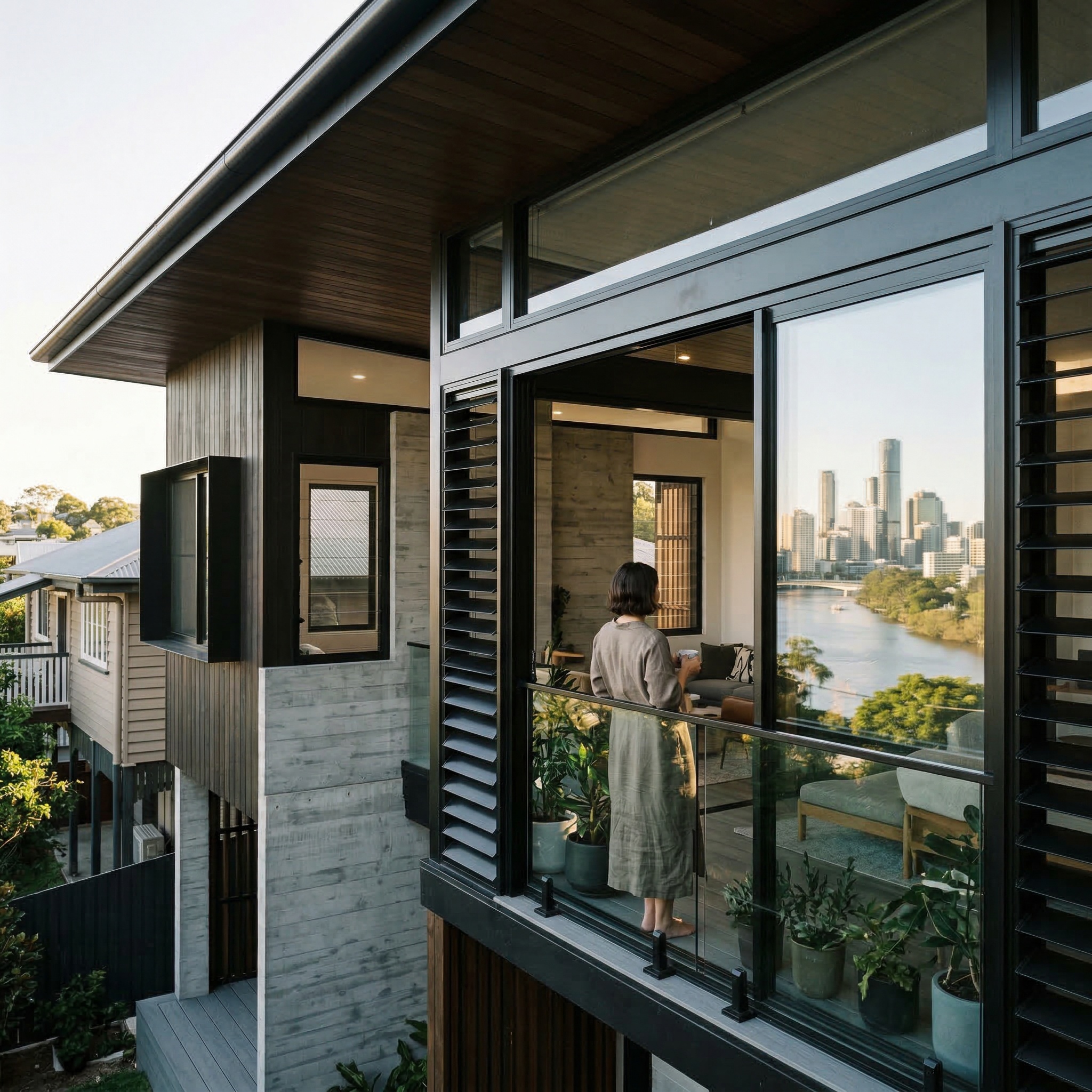
Brisbane's hillside locations offer some of the most spectacular urban vistas in Australia, and view capture is the dominant design driver on virtually every steep-site brief we receive. The approach we take is what we think of as a "view corridor" philosophy: carefully orchestrated sight lines that frame specific vistas — a stretch of river, the CBD skyline, a particular tree canopy — while screening less desirable elements and managing privacy from neighbouring properties. This is not simply a matter of placing large windows on the view-facing elevation. On dense hillside streets, it requires a sophisticated layering of levels, screening devices, and louvred systems that protect both the view and the occupants' sense of privacy.
The most successful contemporary home architect work we see in Brisbane's hillside suburbs doesn't maximise glazing indiscriminately — it frames views deliberately and manages solar exposure intelligently. Floor-to-ceiling glazing on the river-facing facade is balanced by deep eaves, louvred screening on the east and west, and careful orientation to the prevailing southeast breezes that make hillside living in Brisbane genuinely comfortable for much of the year without mechanical cooling.
Subtropical Modernism and Passive Design on the Hill
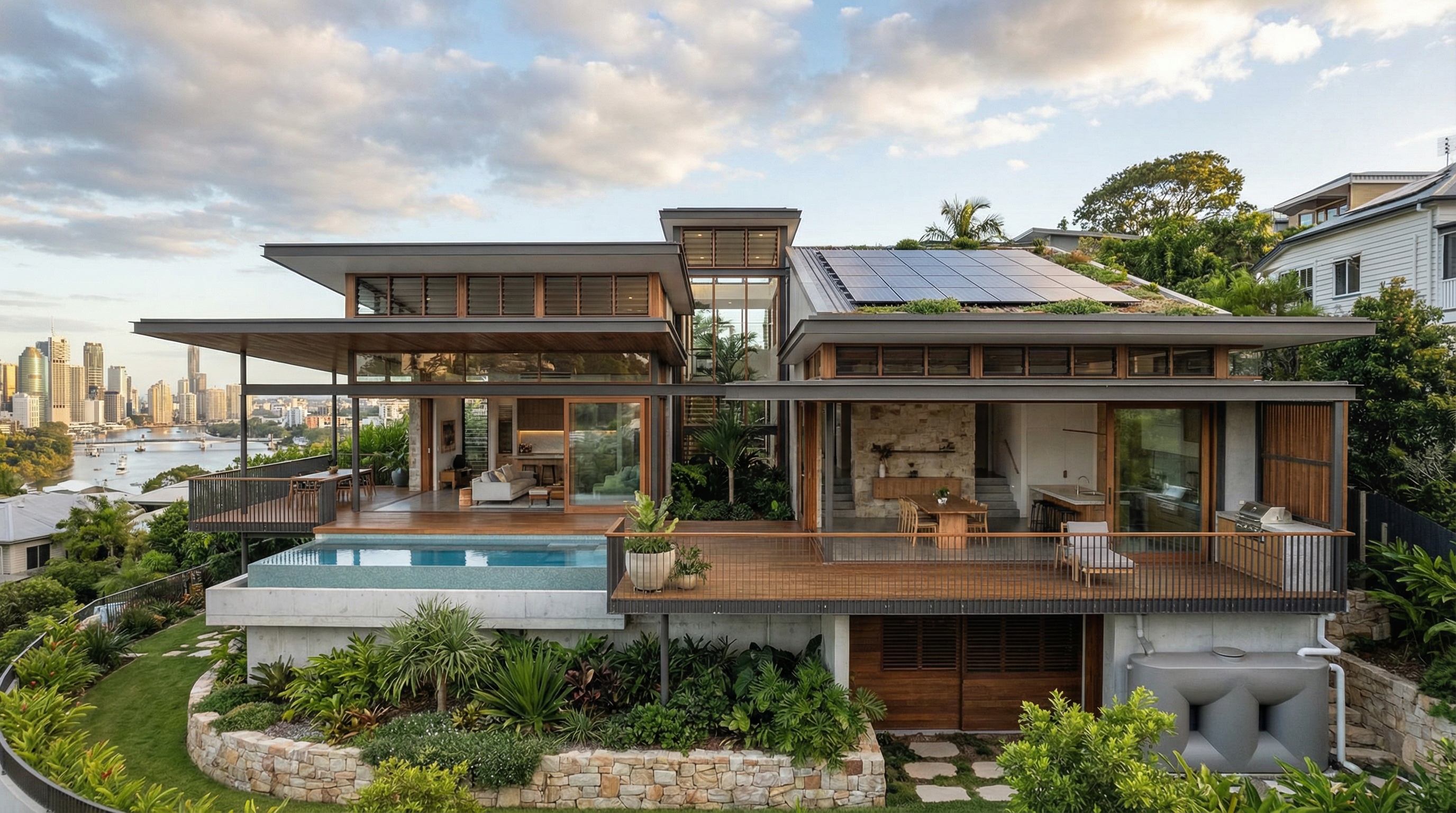
Subtropical modernism as an architectural language is particularly well-suited to Brisbane's hillside sites. The generous eaves, naturally ventilated living spaces, and deep-shaded outdoor rooms that define this tradition perform exceptionally well at elevation — where breezes are more reliable, where the views reward a building that reaches toward them, and where the section of a multi-level home creates natural opportunities for stack ventilation between levels. As a subtropical modernism architect in Brisbane, this is the language we return to on hillside sites because it works climatically, it ages well, and it creates homes that feel genuinely specific to their place.
Passive design principles should be embedded in a hillside project from week one of the design process. Orientation, shading, cross-ventilation, and thermal mass are decisions made at concept stage, and they cannot be compensated for later with expensive mechanical systems. At the construction budgets that prestige Brisbane hillside projects command — typically $1.8M to $3.5M for a significant renovation, $3M to $5M+ for a prestige new build — there is no reason to build a home that does not perform well in the climate. An experienced passive design architect in Brisbane working on a hillside site has every advantage: the elevation delivers breezes, the views orientate the building toward cooler aspects, and the section creates natural ventilation opportunities that flat sites cannot replicate.
At this specification level, eco-friendly home design in Queensland has moved well beyond minimum compliance. Clients building at $3M and above routinely include solar and battery systems, rainwater harvesting, high-performance glazing, and whole-home automation in their brief. A luxury sustainable architect in Brisbane approaches these not as additions but as integrated components of the building system — factored into the orientation, roof design, and services layout from the start. Biophilic architecture in Brisbane — design that maintains a genuine connection between occupants and the natural environment through framed views, natural materials, living planting, and water — is particularly well suited to hillside sites, where the surrounding landscape is already the primary attraction.
Hillside Design and the Character Overlay
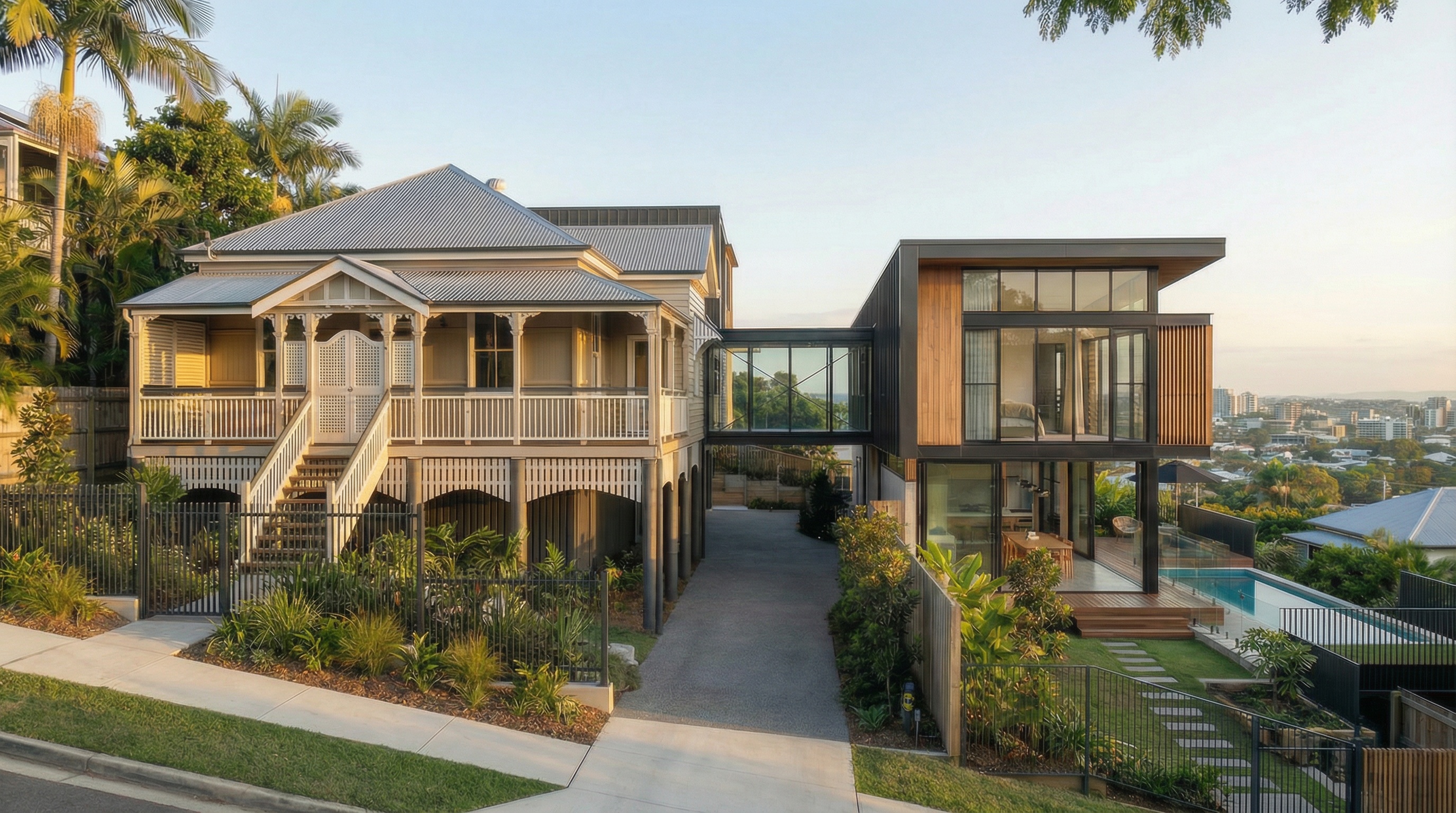
Many of Brisbane's most desirable hillside sites also carry Traditional Building Character (TBC) overlay designations under Brisbane City Plan 2014. In suburbs like Paddington, Hamilton, Bardon, and parts of Red Hill, a significant proportion of the housing stock is protected under the character overlay — meaning that additions and alterations must respond sympathetically to the original building's character, and demolition of pre-1947 structures requires specific assessment.
As heritage architects in Brisbane working regularly in these overlay areas, we have developed a clear methodology for hillside character sites: retain and celebrate at the street, add a clearly articulated contemporary structure at the rear, and treat the connection between old and new as a considered design gesture rather than a seam. The hillside condition adds a layer of design opportunity that flat character sites cannot offer — the original home sits at street level while the new addition drops away behind and below it, producing a contemporary lower level that opens to the garden and pool below the original floor plate. This approach is the backbone of quality Queenslander renovation Brisbane work on steep sites.
Heritage renovation Brisbane on a hillside is also a structural opportunity. The raise-and-build-under approach — taking a timber Queenslander renovation architect brief off its stumps, raising it, and building a full masonry level beneath — is well-suited to steep Brisbane sites. On extreme grades, the under-house level can be dramatically generous in height on the downhill side, producing a three-level home from what was originally a single-storey Queenslander, with the new lower levels substantially larger than the original footprint. Post-war home renovation Brisbane and 1980s house renovation Brisbane projects on sloping blocks follow similar logic: the existing structure, however unremarkable architecturally, often provides a sound platform from which a home renovation architect in Brisbane can generate a genuinely ambitious section by working with the grade rather than ignoring it.
Working with the Right Team on a Hillside Project
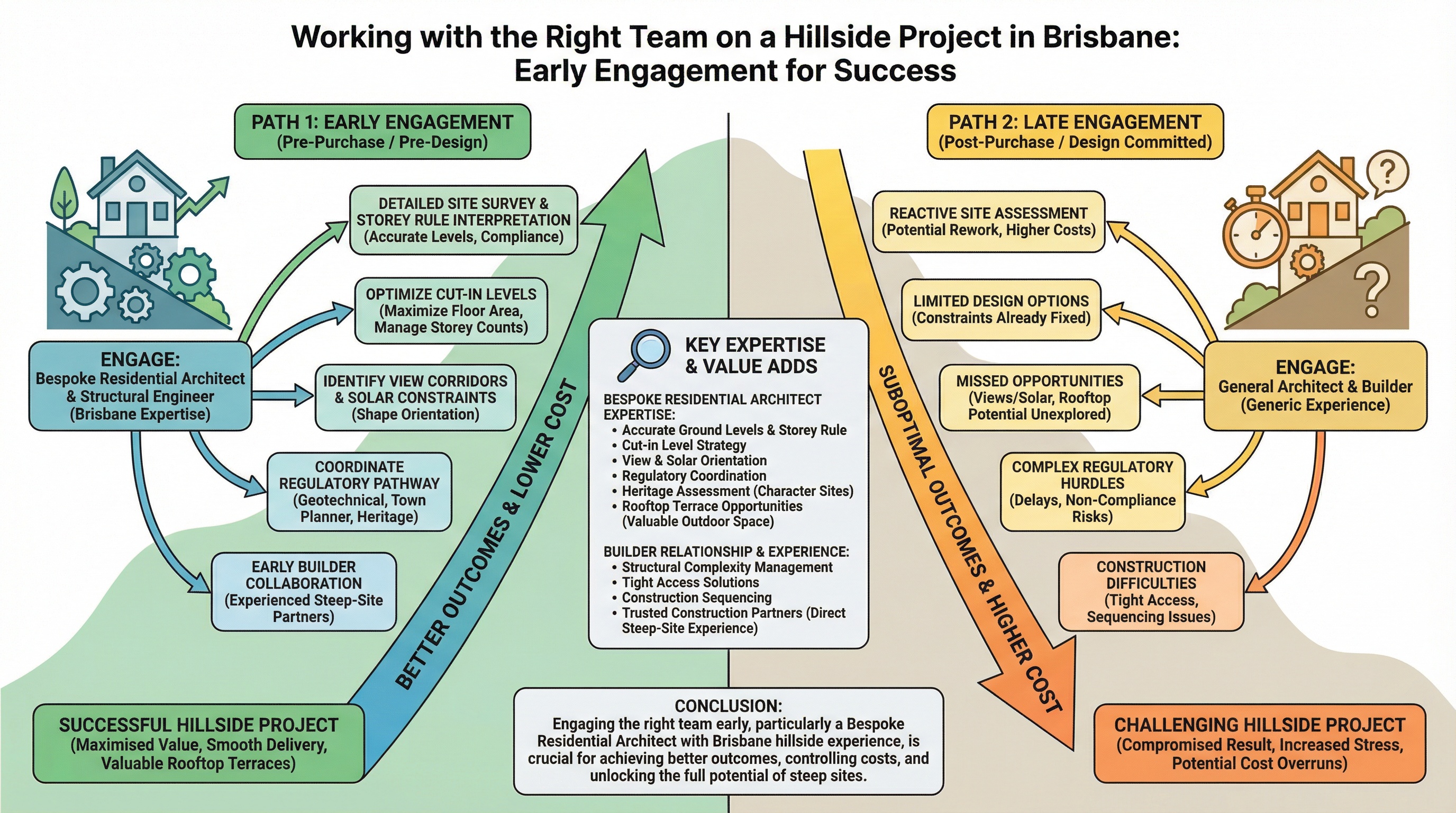
The complexity of hillside development — and the specificity of Brisbane's planning rules for steep sites — means that the team you engage, and when you engage them, has a material impact on what you can achieve. As award-winning architects in Brisbane with a track record on difficult sites across the inner suburbs, we consistently see the same pattern: projects that engage their architect and structural engineer early, before the land is purchased and certainly before any design is committed to, achieve better outcomes at lower cost than those that treat professional engagement as a later-stage activity.
The specific expertise a bespoke residential architect in Brisbane brings to a hillside brief includes: a detailed site survey to establish accurate ground levels and interpret how the storey rule applies to the specific topography; advice on where cut-in levels can be positioned to maximise floor area without triggering additional storey counts; identification of view corridors and solar constraints early enough to shape the building's orientation; and coordination with structural engineers, geotechnical consultants, and town planners to manage the regulatory pathway from the outset. For character overlay sites, this extends to heritage assessment and understanding what council will and will not approve before design work begins.
As residential architects in Brisbane working at the $1.5M–$3M+ construction level, we also bring the builder relationship that steep-site projects require. Not every builder in Brisbane has the experience to manage the structural complexity, tight access, and construction sequencing that a serious hillside project demands. Our working relationship with trusted construction partners who have direct steep-site experience is a material advantage — the planning and design expertise only achieves its potential when matched with a builder who can deliver it on difficult ground.
Rooftop terraces are a further tool worth understanding. Under Brisbane City Plan, rooftop gardens and terraces may not count as an additional storey, subject to meeting specific requirements. This provides meaningful opportunities to create valuable outdoor living space at height — capturing the views that justified the hillside site in the first place — without impacting height calculations. These provisions are not automatic, and require careful documentation and early consultation with a town planner, but they are genuinely available and represent one of the more creative tools a luxury residential architects Brisbane practice can bring to a steep-site brief.
What a Hillside Project in Brisbane Typically Involves
For a full renovation of an existing hillside home — structural rationalisation, new additions, pool and entertaining deck, contemporary kitchen and bathrooms — budget $1.8M to $3.5M depending on scale and site difficulty. Sites with significant retaining, piling, or complex stormwater engineering add more. Character overlay sites on steep ground, where heritage renovation requirements compound the hillside engineering, represent the most complex and costly category.
For a prestige new build on a steep Brisbane site — full-site development, contemporary design, quality fitout, pool, and the structural and waterproofing infrastructure required to manage the grade — total project costs typically start at $3M and can extend well above $5M for landmark properties with exceptional views and high specification.
Approval timelines depend on overlay status and site complexity. A standard non-overlay new build on a sloping block may require only a building approval. A character overlay renovation, a site with significant cut-and-fill, or a riverfront property with flood overlay considerations will typically require a development application through Brisbane City Council — with four to eight months for DA approval a realistic expectation. Budget for geotechnical and hydraulic assessments before design commences on any site with significant grade change.
These are not projects suited to volume builders or project home companies. The planning nuance, structural demands, and the expectations of Brisbane's prestige residential market require a custom home architect in Brisbane — someone who has navigated steep sites, produced detailed DA documentation for council, and has a trusted builder relationship capable of delivering on difficult ground.
Working with Quorum Studios on a Hillside Project
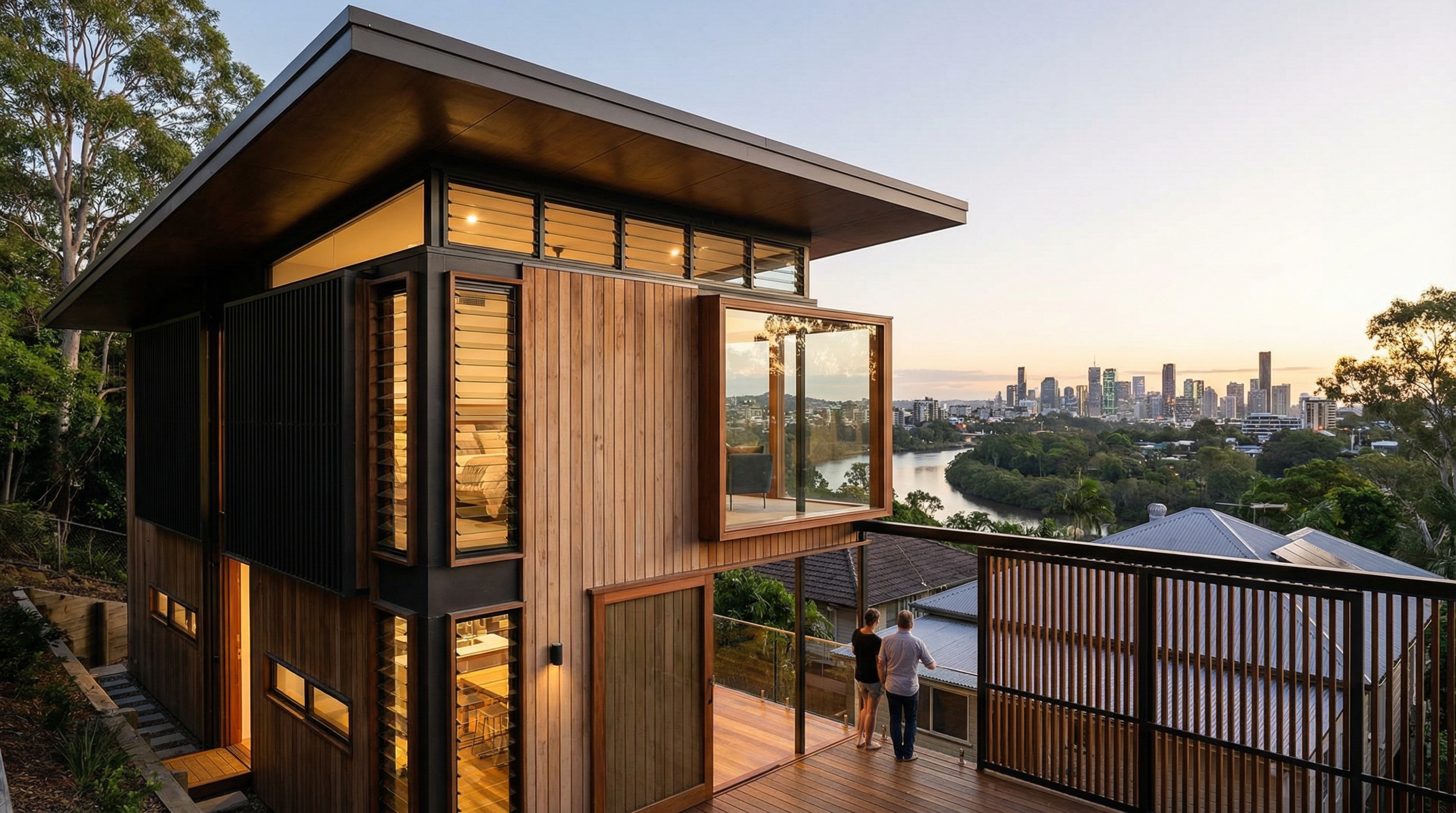
We are a boutique architecture studio based in Newstead, Brisbane. Our work as high-end residential architects is concentrated in the inner prestige suburbs where Brisbane's hillside conditions are most demanding and most rewarding: Hamilton, Ascot, Paddington, Bardon, Red Hill, New Farm, and the surrounding character corridors. We have deep experience with Brisbane City Council's character overlay on steep sites, strong relationships with structural engineers and town planners who understand this terrain, and a design approach that treats the site's topography as the primary design driver.
Whether the brief calls for a luxury home architect in Brisbane to lead a prestige new build, a Brisbane renovation architect to transform a tired hillside estate, or a house extension architect in Brisbane to add a contemporary rear wing to a character home on a sloping block — our process starts with the site. Before a line is drawn, we understand the grade, the view angles, the overlay status, the flood and noise mapping, and the driveway geometry. That means our clients understand what's achievable, what the approval pathway looks like, and what a realistic project cost is — including the hillside premium — before they commit to design fees or construction programmes.
As an architect Brisbane clients have recognised in the HIA and Master Builders award programmes, and as a practice with close involvement in industry judging, we stay close to the standard of work being produced across the Brisbane prestige residential market. If you're considering engaging a Brisbane architect for a hillside project, we'd encourage you to look at the full picture: planning track record, builder relationships, steep-site portfolio, and principal involvement in your project from first conversation to completion.
Quorum Studios is a boutique architecture studio based in Newstead, Brisbane. We work as luxury residential architects and bespoke residential architects across Brisbane, the Gold Coast, and the Sunshine Coast, specialising in high-end new homes, Queenslander renovations, character home renovations, and sloping block architecture. Construction budgets from $1.5M.
Disclaimer: The content in this article reflects our professional opinions and general observations as architects practising in Brisbane. Planning rules, council requirements, storey calculation interpretations, construction costs, and market conditions change regularly. All information should be independently verified with Brisbane City Council, a registered town planner, and other qualified consultants before making any design or property decisions. Nothing in this article constitutes formal planning, legal, or financial advice.

Ready to begin your home design journey?
Request a Consultation