Building or Renovating in Hamilton: Steep Sites, River Views, and the Prestige New Build
By Manny Pedro, Co-founder & Principal Architect, Quorum Studios —Newstead, Brisbane
Hamilton is defined by its topography, its dramatic relationship with the Brisbane River, and a housing stock that spans everything from early-twentieth-century hillside estates to contemporary prestige new builds on the northern slopes. The suburb sits roughly seven kilometres northeast of the CBD, postcode 4007, and its residential streets climb steeply from Kingsford Smith Drive up to Hamilton Hill — one of the highest residential points in the inner north of Brisbane.
As residential architects in Brisbane, we work on projects across the Hamilton Hill and the river corridor regularly. It is one of Brisbane’s most architecturally interesting residential suburbs — and also one of its most technically demanding. The sites here reward careful design, and punish shortcuts. If you are looking for architects in Hamilton, Brisbane, this guide gives you an honest picture of what the suburb actually involves.
This guide is written for homeowners, buyers, and developers thinking seriously about building or renovating in Hamilton. Not a lifestyle overview — those are easy to find — but a practical architectural lens on what this suburb actually demands, and what it means to do it well.
“Hamilton's topography is its greatest asset and its mostpersistent challenge. The view is never free.”
Understanding Hamilton's Geography
Hamilton divides roughly into two zones, historically separated by Kingsford Smith Drive. To the north and west, the land rises steeply — Hamilton Hill reaches around 64 metres above sea level — and the residential streets are characterised by narrow frontages, significant grade changes, and homes that have been incrementally added to over decades as successive owners have tried to capture or expand views toward the city and river. These are the streets that produce the most architecturally complex briefs we handle in this corridor.
To the south and east, the land flattens toward the river, and this zone has been progressively redeveloped as part of the Northshore Hamilton Priority Development Area (PDA). This is where the master planned precincts — Hamilton Reach, Hamilton Northshore, and the former port lands — sit. The PDA is assessed by Economic Development Queensland (EDQ) rather than Brisbane City Council, which means the planning pathway for projects within it is fundamentally different from a standard residential DA.
Between these two zones are the streets that most buyers are looking at when they say "Hamilton" — the mid-hill residential streets where the views are good, the blocks are generous, and the planning context is a mix of character overlay and standard residential code. This is where the most interesting renovation and new build work in Hamilton tends to happen.
The Traditional Building Character Overlay in Hamilton
.png)
Significant parts of Hamilton fall under Brisbane City Council’s Traditional Building Character (TBC) overlay under City Plan 2014. The character of the housing stock on Hamilton Hill is varied — there are grand pre-war hillside estates alongside post-war brick homes alongside 1970s and 1980s constructions, not all of which carry overlay protection. Two neighbouring properties can have entirely different planning constraints, which makes checking overlay status for any specific address before purchase essential.
Where the TBC overlay applies in Hamilton, the requirements are consistent with those across Brisbane: street-facing additions must be sympathetic with the original building’s character, demolition of pre-1947 structures requires specific assessment, and visible rooflines and materials are subject to council scrutiny. For the hillside sites — where much of the addition logic involves building up rather than back, to capture views over the ridge — navigating the overlay while achieving the brief can require genuinely creative design solutions. Heritage architects in Brisbane who also understand steep-site construction are not a common combination. A renovation architect in Brisbane with direct hillside experience and a track record in character home renovation is a material advantage on these sites.
It is worth noting that some of Hamilton's most dramatic and view-commanding streets carry limited or no TBC overlay, simply because the housing stock on them was replaced during the mid-twentieth century. These non-overlay sites represent some of the strongest knockdown-rebuild opportunities in the suburb, and they are keenly sought for that reason.
.png)
What Hamilton's Sites Actually Demand
Steep Sites and Structural Complexity
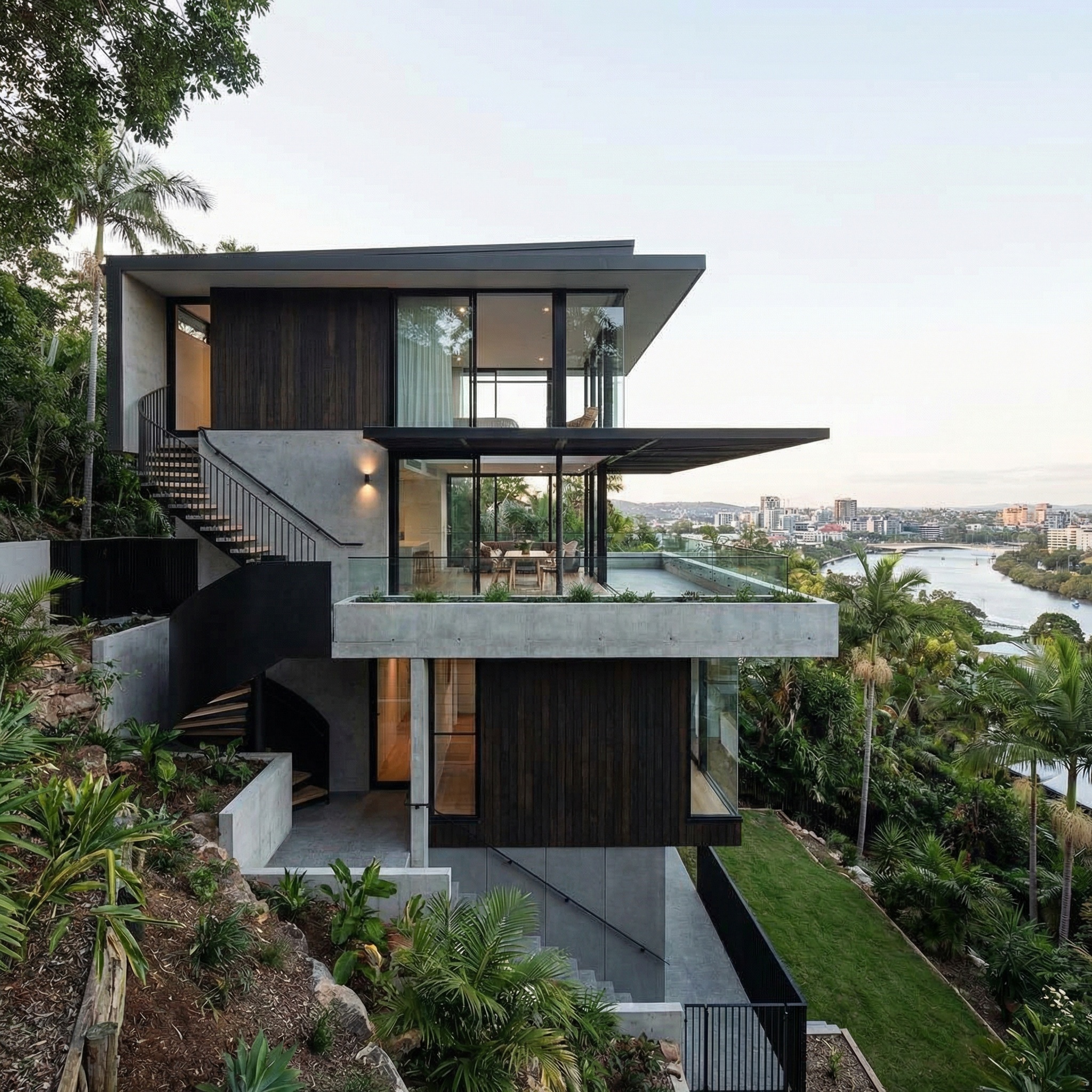
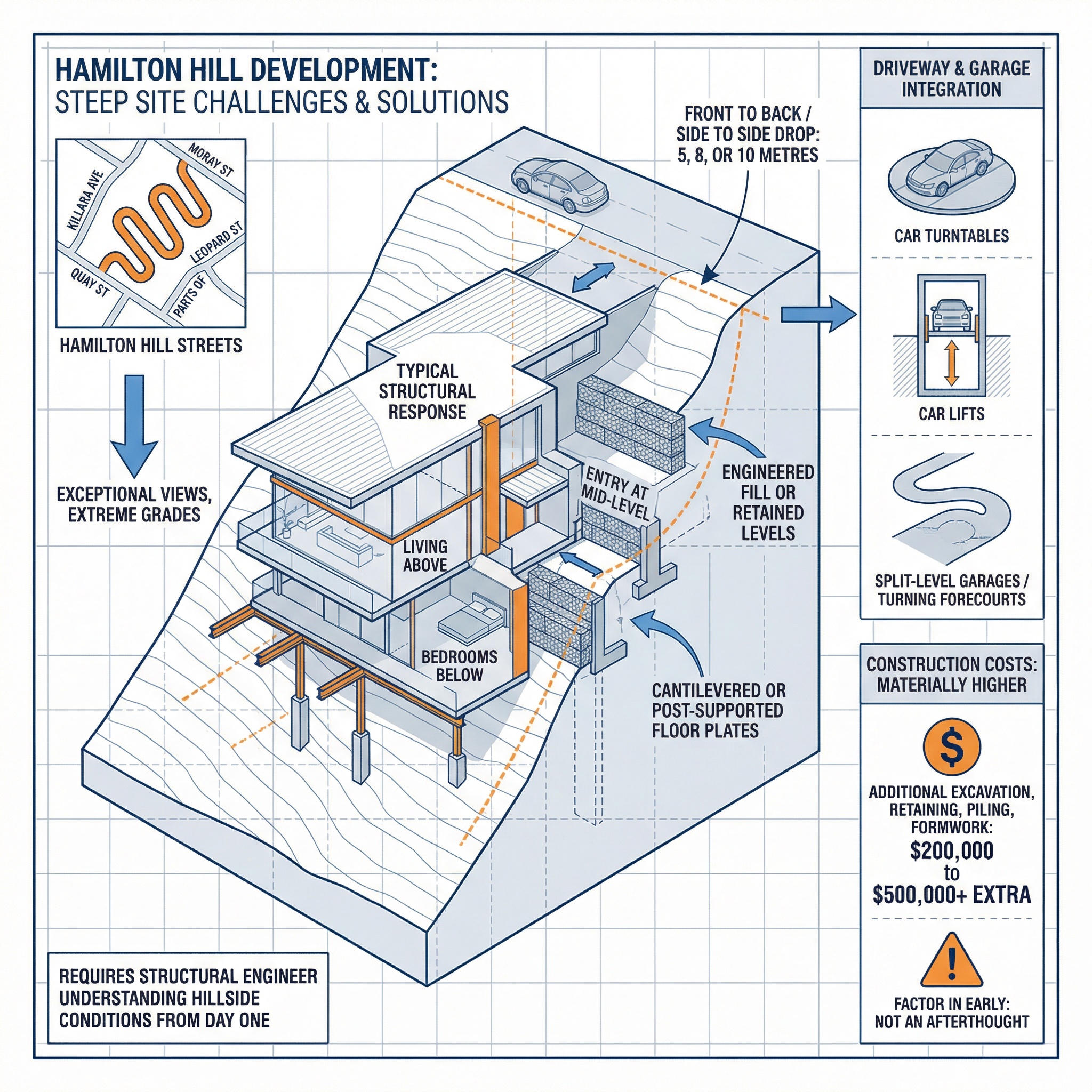
The most sought-after streets on Hamilton Hill — Killara Avenue, Moray Street, Quay Street, parts of Leopard Street — have exceptional views but come with sites that can drop five, eight, or ten metres from front to back or side to side. Building on these sites requires a structural engineer who understands hillside conditions from day one, not as an afterthought once design is underway.
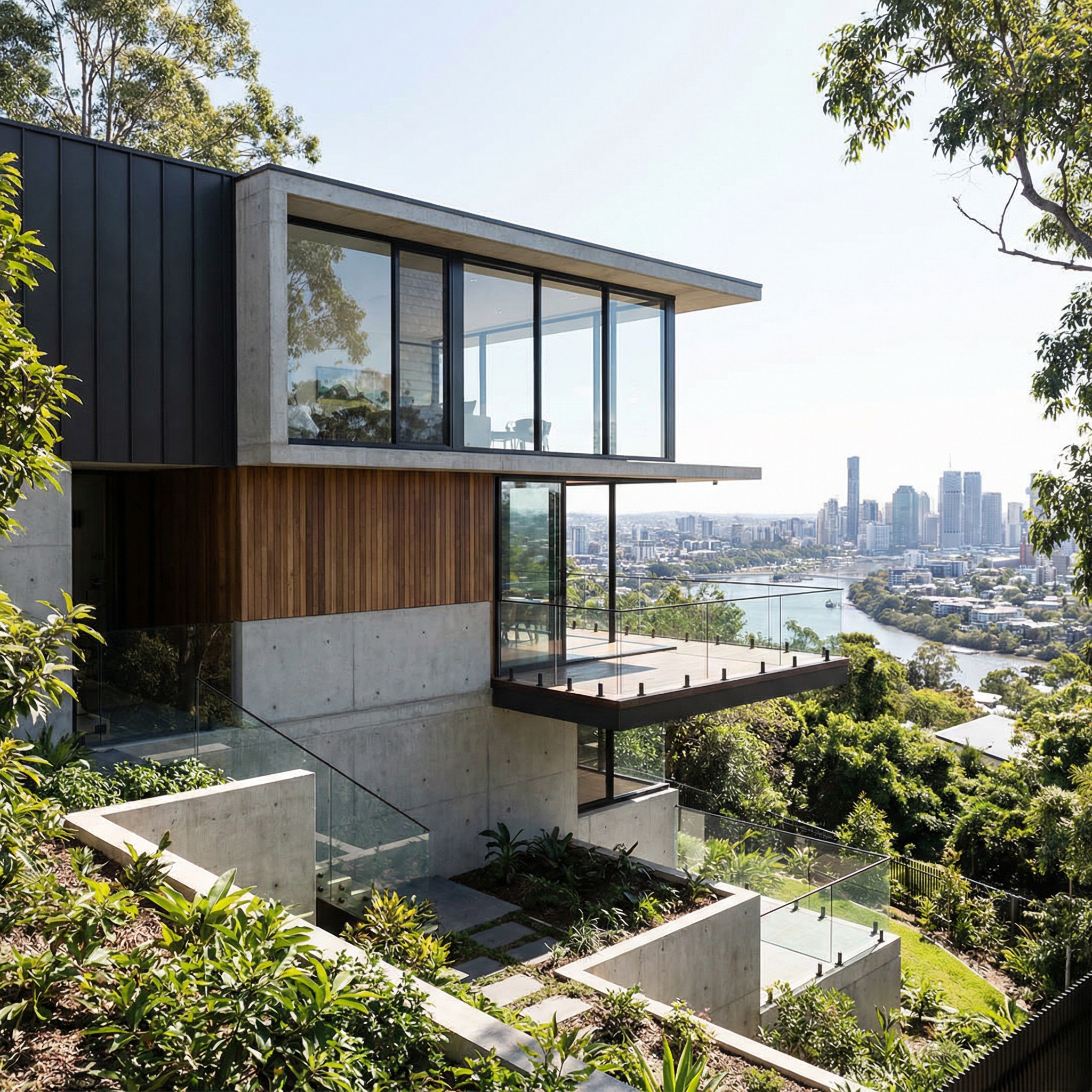
The typical structural response on a steep Hamilton site is a combination of engineered fill or retained levels, cantilevered or post-supported floor plates, and a multi-level section that distributes the program across the grade rather than fighting it. Entry at mid-level is common, with living above and bedrooms below — or vice versa depending on the view orientation and the existing structure. Driveway design and garage integration are often more technically challenging than the house itself. Manoeuvring a prestige vehicle on a steeply graded site with a narrow frontage is a problem that requires early design attention, and one that experienced sloping block architects in Brisbane have developed specific responses to — car turntables, split-level garages, car lifts, and dedicated turning forecourts are all common resolutions.
Construction costs on steep Hamilton sites are materially higher than flat suburban equivalents. Additional excavation, retaining, piling, and formwork can add $200,000 to $500,000 or more to a comparable project on flat land — sometimes significantly more on extreme grades. Clients who are comparing Hamilton builds to hypothetical flat-site alternatives need to factor this in at the start of the conversation, not at the end of design.
Flood Planning and River-Adjacent Sites
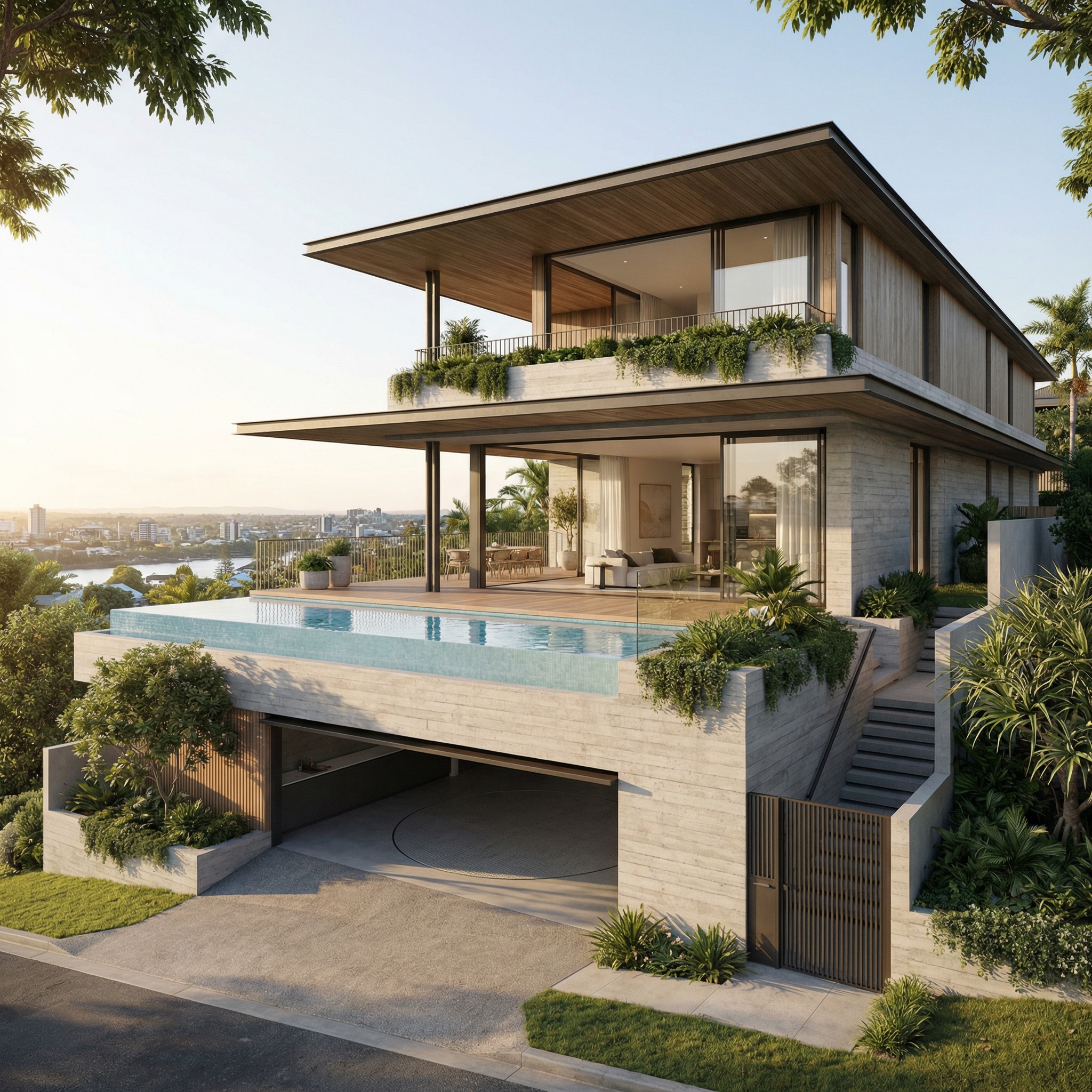
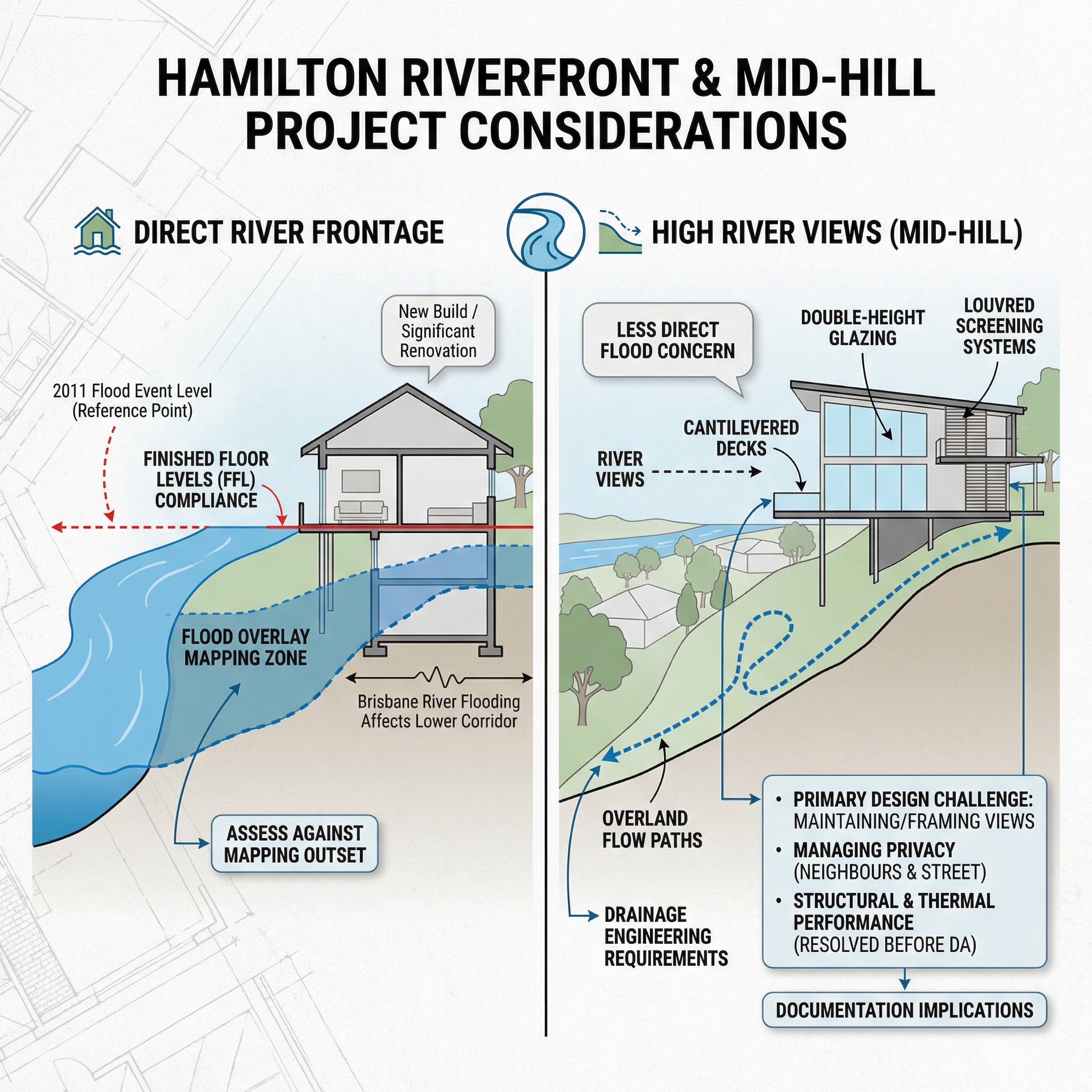
Homes with direct river frontage or high river views form a distinct category of project in Hamilton, and they involve a specific set of overlay considerations. Despite Hamilton's general elevation, Brisbane River flooding affects properties along the lower river corridor — the 2011 flood event remains a reference point for Brisbane City Council assessors and individual homeowners alike. Any new build or significant renovation on a river-adjacent site should be assessed against the flood overlay mapping from the outset, and finished floor levels must comply with applicable requirements.
For homes on the hill with river views rather than direct frontage, flood planning is typically less of a direct concern — though overland flow paths on some of the steeper sites can create their own drainage engineering requirements. The primary design challenge at mid-hill is maintaining and framing river views while managing privacy from neighbouring properties and from the street. Double-height glazing, cantilevered decks, and louvred screening systems are common elements in this typology — each with specific structural and thermal performance implications that need to be resolved in the documentation before going to DA.
Aircraft Noise and Aspect
Hamilton's western and southern slopes face toward the CBD and the river — the most desirable orientation for view capture. However, properties on the eastern side of Hamilton Hill, and those in the lower-lying streets closer to Kingsford Smith Drive, can sit within the aircraft noise overlay. Since the second runway at Brisbane Airport became operational, this has been a more significant factor for high-specification homes targeting acoustic comfort, home cinema, or quiet outdoor entertaining.
For a prestige home at the level of specification most Hamilton clients are aiming for, acoustic glazing, mechanical ventilation, and a well-considered outdoor room design can manage the noise overlay effectively — but these elements need to be designed in from the start rather than retrofitted. Checking the specific noise contour for any address of interest is worth doing before purchase.
The Architecture of Hamilton: What You're Working With
The Hillside Estate Typology
Hamilton's most distinctive residential form is the multi-level hillside home — often a pre-war or mid-century structure that has been extended across multiple generations, sometimes resulting in a layered, complex section that no longer performs well as a whole. These homes can sit on three or four split levels, with additions at the front, back, and beneath the original structure, connected by staircases that reflect decades of pragmatic decision-making rather than considered design.
The renovation brief for this typology is often one of rationalisation as much as addition — stripping back the accumulated additions to a clear structural framework, then rebuilding around it with a coherent spatial logic, contemporary services, and the view-facing connections that the original dwelling either couldn’t achieve or addressed only partially. Post-war home renovation and 1980s house renovation projects in Brisbane are a particular speciality for us: the bones of these homes are often sound, but the layout, services, and thermal performance have aged poorly. This kind of forensic renovation requires a home renovation architect in Brisbane with both design skill and a methodical approach to understanding what an existing building is doing structurally — before deciding what to keep.
Queenslanders on the Hill
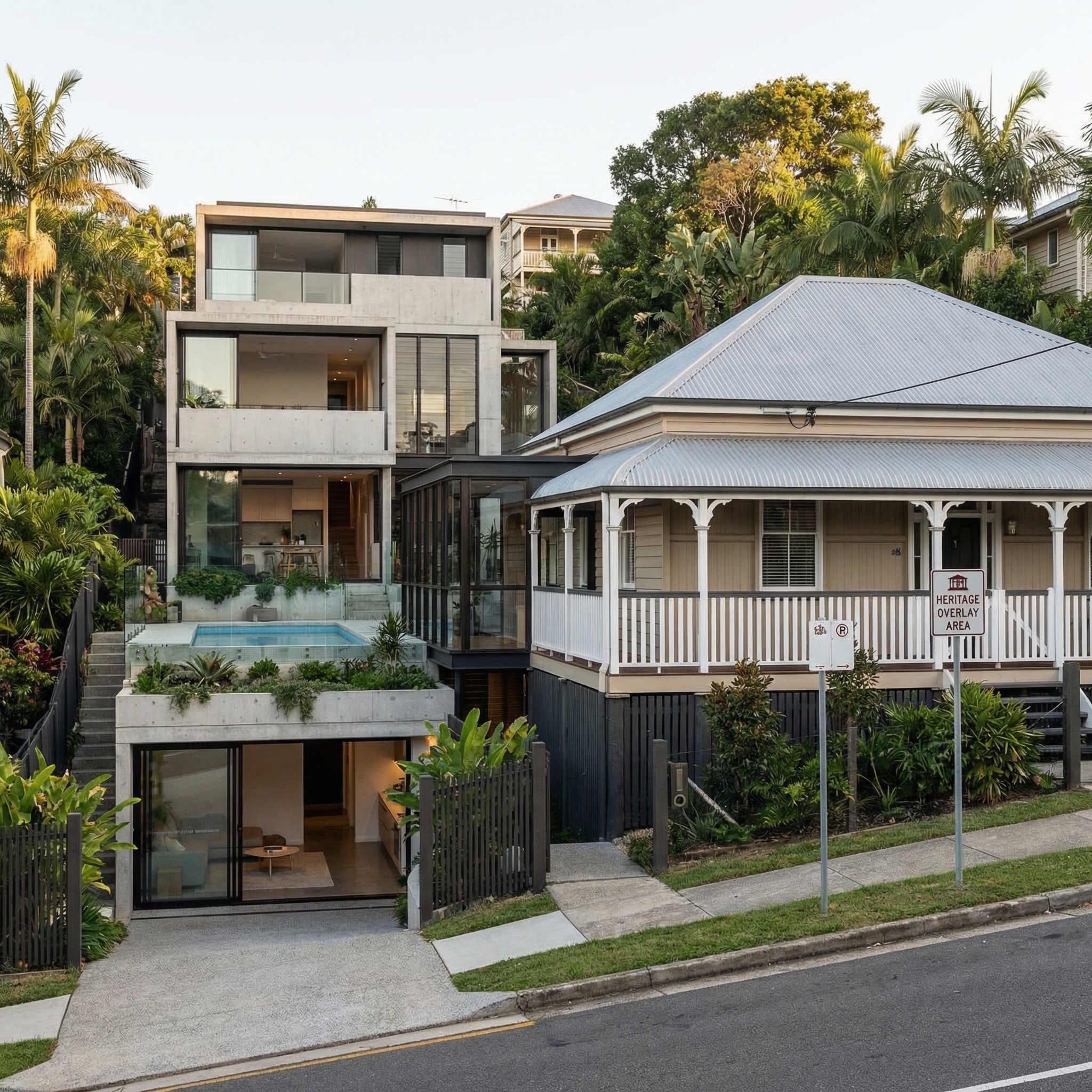
Where Queenslanders exist on Hamilton Hill under TBC overlay protection, the approach follows the same logic that governs character renovation across Brisbane — retain and celebrate at the street, add a clearly articulated contemporary structure at the rear, and manage the connection between old and new as a considered design gesture rather than a seam. What Hamilton’s topography adds is a layer of design opportunity that flat suburban sites simply cannot offer. The original Queenslander may sit at street level while the new addition drops away behind it, delivering a contemporary lower level that opens to the garden and pool below the original floor plate — an arrangement that can feel entirely separate from the heritage home above, while remaining physically connected.
The raise-and-build-under approach — taking a timber Queenslander off its stumps, raising it, and building a full lower level in masonry beneath — is well-suited to Hamilton’s hillside sites. As Queenslander renovation architects in Brisbane, this is one of the more rewarding briefs we work with: the heritage renovation process calls for genuine care with the original fabric, while the hillside condition gives the house extension an architectural ambition that flat suburban sites rarely match. The steep terrain means the under-house level can be dramatically generous in height on the downhill side. On the right site, this approach can produce a three-level home from what was originally a single-storey Queenslander, with the new lower levels substantially larger than the original footprint.
Prestige New Builds
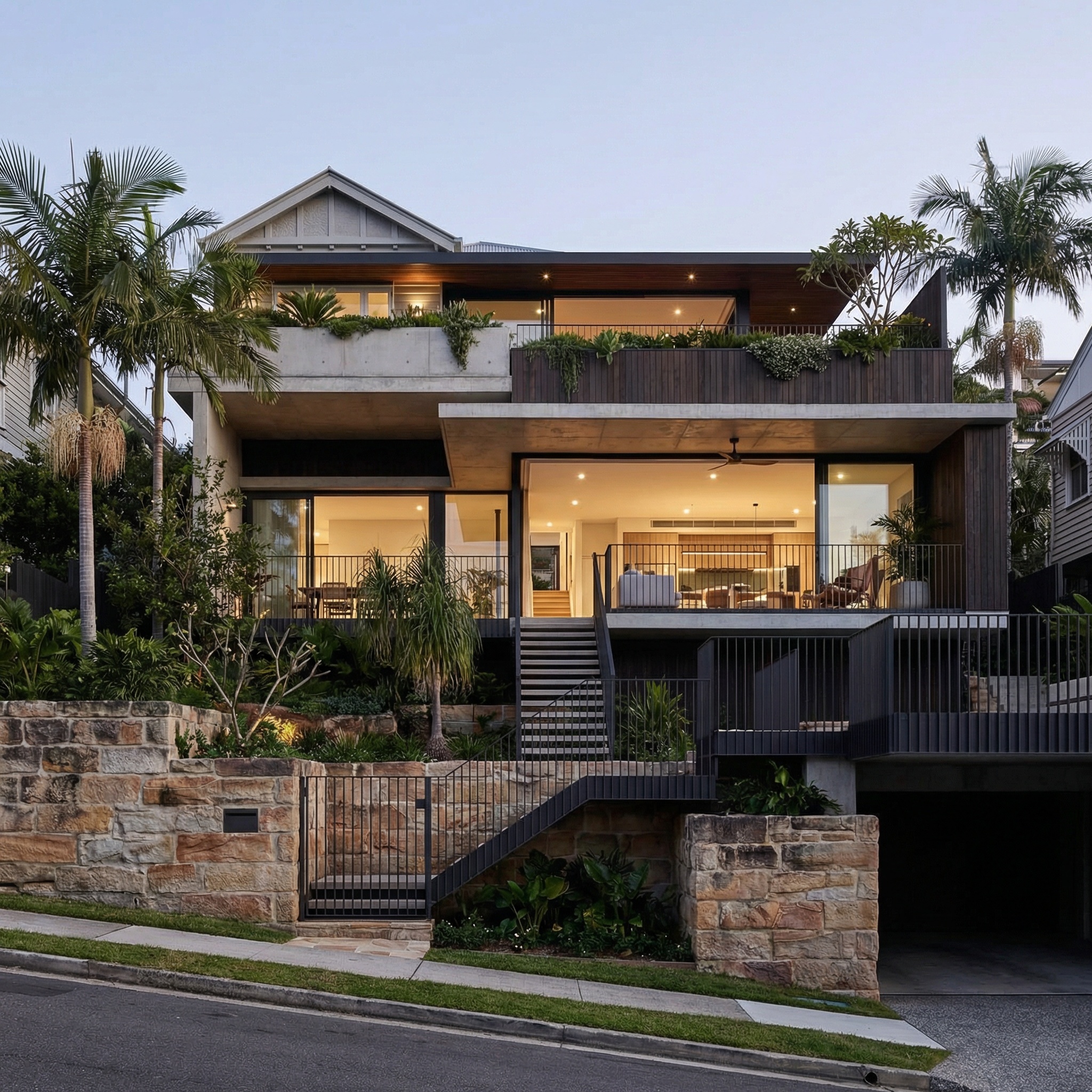
Hamilton has a strong tradition of bespoke new builds, supported by the availability of non-overlay blocks and a hillside condition that makes knockdown-rebuild a natural decision where the existing structure doesn’t justify the cost and complexity of working around it. For a prestige new build on Hamilton Hill, the design brief typically includes a strong relationship to views across multiple levels, generous indoor-outdoor entertaining at the main living level, a parent retreat with a view-facing deck, double or triple garaging at street entry level (often with a car lift or turntable given site constraints), and a pool positioned to maximise sun and privacy rather than street visibility.
The best new homes we see in Hamilton don’t try to reproduce a suburban typology on a hillside — they work with the section, allow the site to shape the program, and use the view as a design generator rather than a bonus. The result is architecture that feels specific to its place in a way that flatland homes rarely achieve. Subtropical modernism — generous eaves, naturally ventilated living, deep-shaded outdoor rooms — is the appropriate architectural language for a contemporary home architect in Brisbane working at this level: it performs well in the climate, it ages gracefully, and it creates homes that genuinely feel as though they belong where they are built.
“A well-designed Hamilton build earns its view. The site demandsit, and the best results come from architects who treat that demand as anopportunity rather than a constraint.”
.png)
Design and Sustainability: How Hamilton Homes Should Perform
At the construction budgets Hamilton projects command, there is no excuse for a home that performs poorly in the climate. Passive design is the starting point: orientation, shading, cross-ventilation, and thermal mass are decisions made in the first week of design, and they cannot be compensated for later with expensive mechanical systems. A passive design architect in Brisbane working on a hillside site has every advantage — the elevation delivers reliable breezes, the views dictate orientation toward the cooler westerly and southerly aspects, and the section creates natural opportunities for stack ventilation through the vertical separation of levels.
Biophilic architecture — design that maintains a genuine connection between the occupants and the natural environment — is not a trend at this level of the market, it is an expectation. Clients building on Hamilton Hill are surrounded by established canopy, river views, and the particular quality of light that comes with elevation. The best homes we work on treat those elements as primary design material: framed views, natural materials, living green walls, water features that are audible from the outdoor room, and a planting strategy that makes the garden feel like an extension of the interior rather than an afterthought around it.
Eco-friendly home design in Queensland is increasingly being driven by client expectation rather than regulatory minimum. Clients building at $3M and above are routinely requesting solar and battery systems, rainwater harvesting, high-performance glazing, and whole-home automation that manages energy use intelligently. A luxury sustainable architect in Brisbane approaches these not as add-ons but as integrated components of the building system — factored into the orientation, the services layout, and the roof design from the earliest concept stage.
Interior specification at the Hamilton prestige level demands the same rigour as the architecture. The line between the architect’s role and the interior designer’s role is often blurred at this end of the market — and intentionally so. Luxury interior design in Brisbane, when integrated with the architecture from the start rather than layered over it afterward, produces spaces where the material palette, the joinery design, the lighting, and the furniture all feel resolved as a whole. That coordination is something we manage as part of the design process, working with interior specialists and suppliers who operate at the specification level these projects require.
The Northshore PDA: A Different Planning Context
For clients looking at sites within the Northshore Hamilton Priority Development Area — the redeveloped river corridor south of Kingsford Smith Drive — the planning context is quite different from the hillside residential streets. The PDA is governed by a Development Scheme administered by Economic Development Queensland, not Brisbane City Council's City Plan 2014. This means the traditional building character overlay does not apply, and development applications are assessed by EDQ rather than council.
The Northshore precinct is continuing to evolve, with further riverfront sites progressively coming to market and the broader infrastructure of the precinct maturing. For clients considering bespoke freehold homes within or adjacent to the PDA, understanding the applicable planning scheme and the EDQ assessment pathway is important — it operates on different timelines and with different documentation requirements than a standard BCC DA. The riverfront position and the master planned precinct context can also create specific view corridor, setback, and design code requirements that aren't present in the standard residential zone.
The Hamilton Building Brief: What Clients Are Actually Asking For
Across the Hamilton projects we handle, a consistent set of brief elements emerges — shaped by the site conditions, the client profile, and the suburb's particular relationship to the city and river.
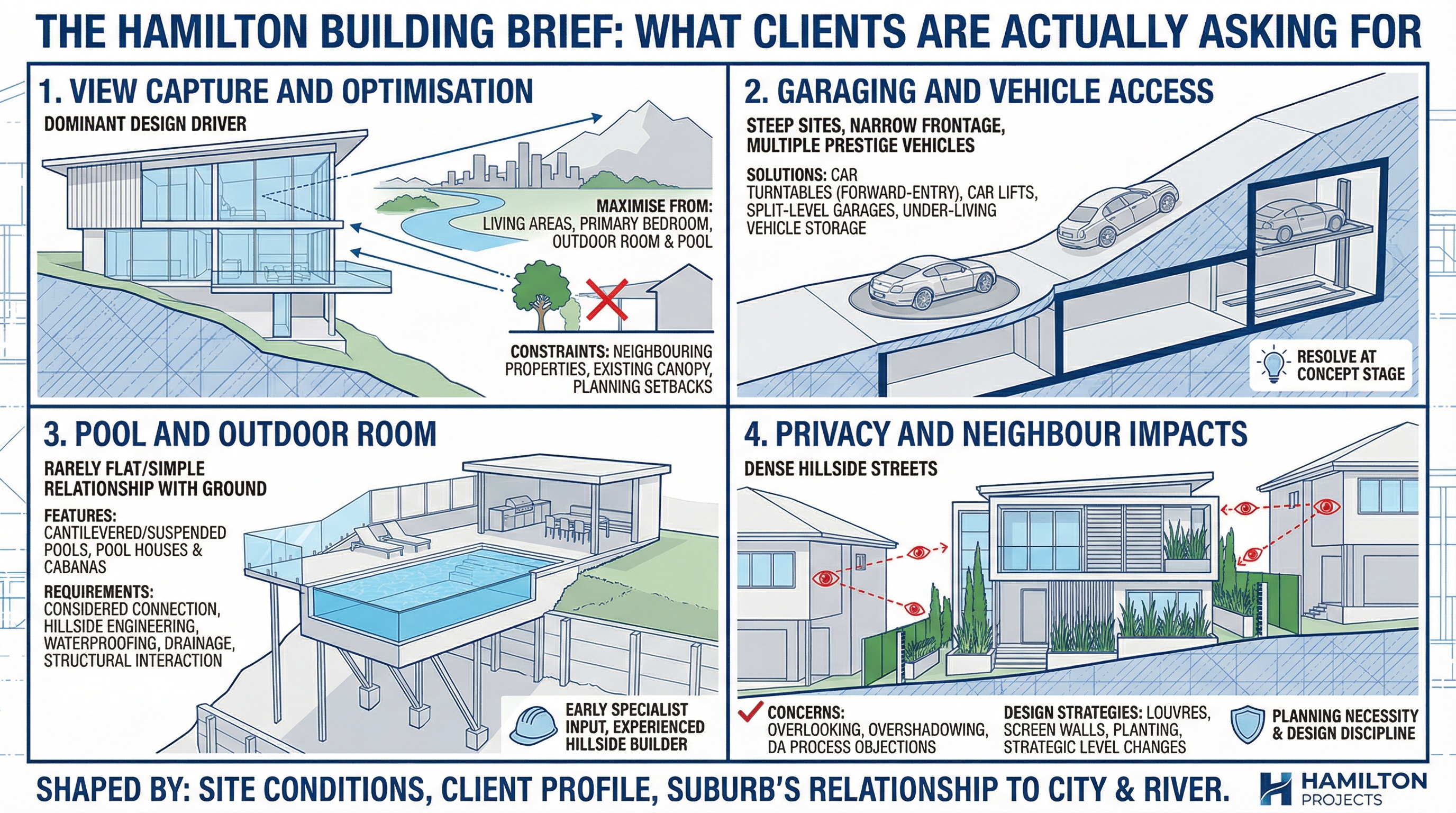
View Capture and Optimisation
Unsurprisingly, view capture is the dominant design driver on most Hamilton Hill sites. Clients are buying the view — often paying a significant premium for it — and the brief almost invariably includes a directive to maximise it from the main living areas, the primary bedroom, and wherever possible the outdoor room and pool. This is not always straightforward. Neighbouring properties, existing tree canopy, and planning setback requirements can all limit what's achievable at the design stage, and clients benefit from understanding these constraints before design commences rather than discovering them as they review a first sketch.
Garaging and Vehicle Access
Vehicle access on steep Hamilton sites is one of the most technically involved aspects of the brief. A narrow frontage, a significant grade change, and a client with multiple prestige vehicles creates a design problem that has no simple solution. Car turntables are common in Hamilton — perhaps more so than in any other Brisbane suburb — because they allow forward-entry garaging on sites where reversing out of a steep driveway is either unsafe or impractical. Car lifts, split-level garages with internal vehicle movement, and purpose-designed vehicle storage below the main living level are all approaches we have developed on Hamilton projects. These elements need to be resolved at concept stage, not detailed in late documentation.
Pool and Outdoor Room
The pool and outdoor entertaining area on a steep Hamilton site rarely has the luxury of a flat, simple relationship with the ground. Pools are often cantilevered or suspended, perched at the edge of a retaining wall, or positioned at a level that requires a considered staircase or lift connection from the main living floor. Pool houses and cabanas are increasingly requested on the larger sites. Getting the engineering, waterproofing, and drainage right on a hillside pool — and resolving the structural interaction with any retained levels below — requires early specialist input and a builder with hillside experience.
Privacy and Neighbour Impacts
Hamilton's dense hillside streets mean that new development — particularly large-scale additions that push upward to capture views — can have significant privacy impacts on neighbouring properties. Council assesses overlooking and overshadowing as part of the DA process, and designs that haven't considered neighbour impacts tend to attract objections that slow or complicate approval. Designing privacy into the building from the start — through the strategic use of louvres, screen walls, planting, and level changes — is both a planning necessity and a design discipline that the best hillside homes treat as an opportunity rather than a constraint.
Streets Worth Knowing in Hamilton
Within Hamilton, there are meaningful differences between the pockets.
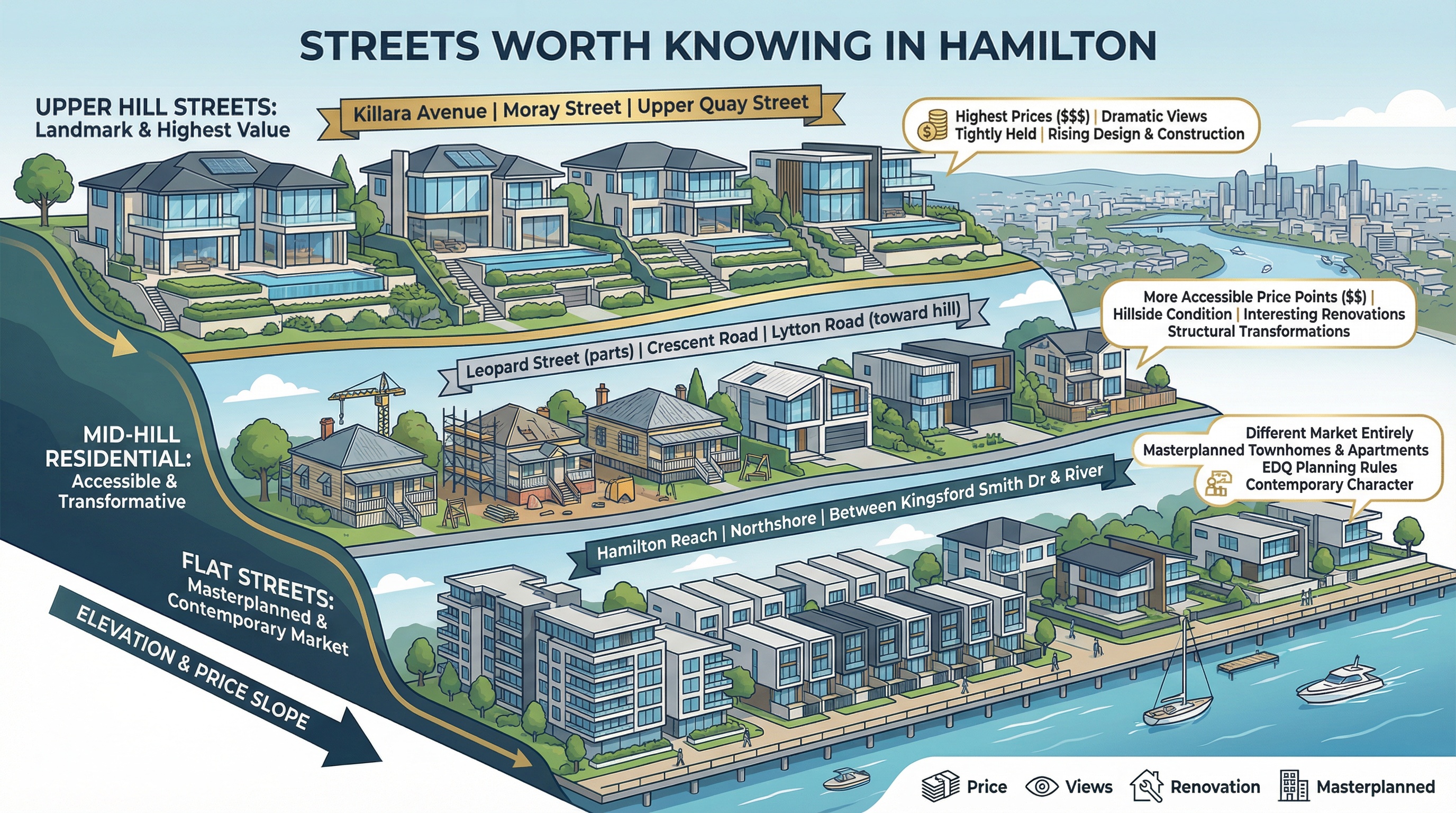
The upper hill streets — Killara Avenue, Moray Street, the upper sections of Quay Street — command the suburb's highest prices and most dramatic views. Blocks here are tightly held, and the level of design and construction on new and renovated homes has been rising steadily over the past decade. These are landmark property streets.
The mid-hill residential streets — parts of Leopard Street, Crescent Road, Lytton Road toward the hill — offer the same fundamental hillside condition with slightly more accessible price points. These streets produce some of Hamilton's most interesting renovation projects, where a structurally sound but architecturally tired home on a generous block is transformed into a considered contemporary residence.
The flat streets between Kingsford Smith Drive and the river — the Hamilton Reach and Northshore precincts — are a different market entirely, characterised by master planned townhomes, apartments, and the occasional bespoke freehold site. The planning rules here (EDQ rather than BCC) and the predominantly contemporary character of the precinct mean the design approach is quite different from the hillside context.
What a Project in Hamilton Typically Involves
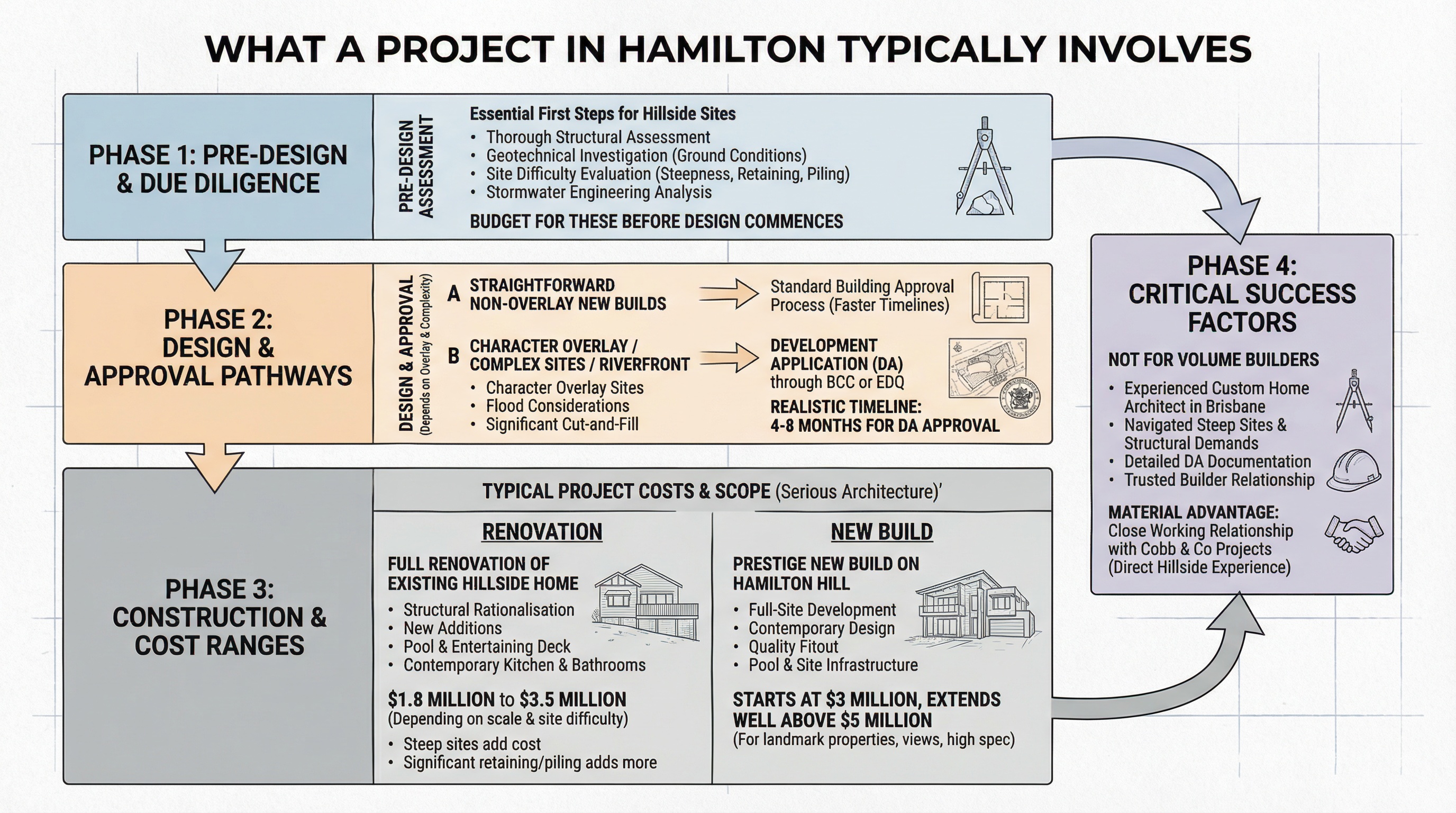
For context on what serious architecture in Hamilton looks like from a process and cost perspective:
A full renovation of an existing hillside home — structural rationalisation, new additions, pool and entertaining deck, contemporary kitchen and bathrooms — typically falls in the $1.8 million to $3.5 millionrange depending on scale and site difficulty. Steep sites add cost; sites with significant retaining, piling, or complex stormwater engineering add more.Clients should budget for a thorough structural and geotechnical assessmentbefore design commences — on a hillside site, the ground conditions can meaningfullyaffect both cost and design strategy.
For a prestige new build on Hamilton Hill — a full-sitedevelopment with a contemporary design, quality fitout, pool, and theinfrastructure required to manage the site's grade — total project coststypically start at $3 million and can extend well above $5 million for landmarkproperties with exceptional views and high specification.
Approval timelines depend on whether the TBC overlay appliesand the complexity of the site. For straightforward non-overlay new builds, astandard building approval process may be sufficient. For character overlaysites, riverfront properties with flood considerations, or projects withsignificant cut-and-fill on the hillside, a development application through BCCor EDQ will be required. Four to eight months for DA approval is a realisticexpectation for these projects.
These are not projects suited to volume builders or projecthome companies. The planning complexity, the structural demands of thehillside, and the expectations of the Hamilton prestige market require anexperienced custom home architect in Brisbane — someone who has navigated steepsites, produced detailed documentation for DA, and has a trusted builderrelationship capable of delivering on difficult ground.
“The clients who get the best results on Hamilton Hill are thosewho bring their architect in before they finalise the purchase — not after. Thesite assessment changes everything.”
Talk to us before you commit
The clients who get the best results in Hamilton start the conversation early — before site purchase, before design fees, before builder selection. We offer a free initial consultation with no obligation.
Call Quorum Studios on 07 2111 8177 or email manny@qstudio.au — or use the contact form below.
Working with Quorum Studios on a Hamilton Project
We are a boutique architecture studio based in Newstead — directly across the river from Hamilton — and the hillside residential streets of this suburb are part of our core working territory. As luxury residential architects in Brisbane, we bring direct experience with Brisbane City Council’s character overlay requirements on hillside sites, strong relationships with structural engineers and town planners who know this precinct, and a design approach that takes the site’s topography as the primary design driver rather than an obstacle to be overcome. Whether the brief calls for a luxury home architect in Brisbane to lead a full prestige new build, or a high-end residential architect to transform a tired hillside estate, we bring the same methodical approach: understand the site first, design second.
Our process starts with a thorough site and planning assessment before a line is drawn. On a Hamilton Hill site, that means understanding the grade, the view angles, the overlay status, the flood and noise mapping, the driveway geometry, and the neighbour context before we begin any design work. It means our clients — whether engaging us as their architect in Brisbane for a new build or as a Brisbane renovation architect transforming an existing hillside home — understand what’s achievable, what the approval pathway looks like, and what a realistic project cost is, including the hillside premium, before they commit to design fees or construction programmes.
We have been recognised in the HIA and Master Builders award programmes — award-winning architects in Brisbane whose recognition reflects the standard we hold ourselves to on every project, not just the ones entered for judging. We also maintain close involvement in industry judging, which means we stay close to the standard of work being produced across the prestige residential market. If you’re considering a Brisbane architect for a Hamilton project, we’d encourage you to look at the full picture: planning track record, builder relationships, and the principal’s direct involvement in your project from first conversation to completion. Quorum Studios is a bespoke residential architect practice in the truest sense — every project is different, every site is treated on its own terms, and there is no junior team handling your brief while the principal moves on to the next client.
QuorumStudios is a boutique architecture studio based in Newstead, Brisbane. We are luxury residential architects and bespoke residential architects working across Brisbane, the Gold Coast, and the Sunshine Coast, specialising in high-end newhomes, Queenslander renovations, character home renovations, and subtropical modernism. Construction budgets from $1.5M.
Disclaimer: The content in this article reflects our professional opinions and general observations as architects practising in Brisbane. Planning overlays, council requirements, construction costs, and market conditions change regularly. All information should be independently verified with the relevant authorities —including Brisbane City Council, Economic Development Queensland, a registered town planner, and other qualified consultants — before making any significant property or design decisions. Nothing in this article constitutes formalplanning, legal, or financial advice.
— Related reading: Ascot | New Farm | Teneriffe | Paddington |Bulimba & Hawthorne | Chandler & Fig Tree Pocket

Ready to begin your home design journey?
Request a Consultation