Ascot, Brisbane: a Building & Renovating Guide for Homeowners
Suburb Guide — Ascot, Brisbane (4007)
Building or Renovating in Ascot: What Every Homeowner Needs to Know
By Manny, Co-founder & Principal Architect, Quorum Studios — Newstead, Brisbane
If there's one suburb in Brisbane where architectural ambition meets genuine planning complexity, it's Ascot. Roughly seven kilometres north-east of the CBD, this is a suburb that rewards people who approach it with patience and expertise — and catches out those who don't.
We're residential architects based in Brisbane, and we work with clients across the prestige northern corridor regularly. Ascot projects tend to arrive with a particular set of conditions: large blocks with significant canopy, Queenslanders under character overlay protection, tight streetscape requirements, and clients who have a very clear picture of what they want but aren't always aware of what council will and won't permit.
This guide is written for anyone thinking about buying, building or renovating in Ascot — not as a general lifestyle overview (there are plenty of those), but as a practical architectural lens on what this suburb actually demands.
Ascot is not a suburb where you buy a block and build what you like. It's a suburb where the land, the planning history, and the street itself all have a view on what should be there.
What Makes Ascot Architecturally Distinctive?
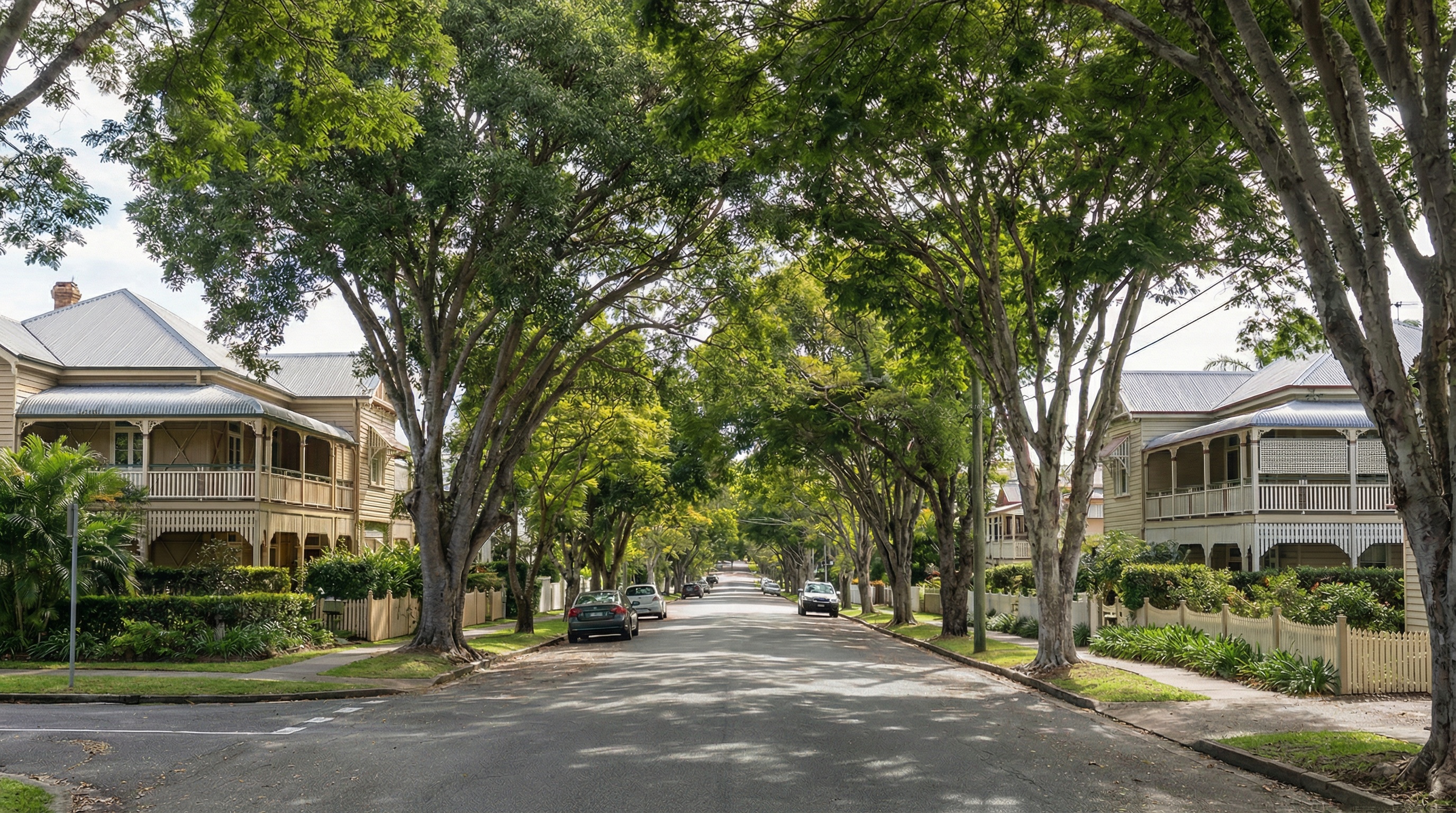
Ascot's built character comes from a combination of factors that aren't replicated anywhere else in Brisbane. Large allotments — many in the 600 to 1,000-plus square metre range — host predominantly pre-war homes, most of them elevated Queenslanders set well back from the street behind mature gardens. The streets themselves are wide and heavily canopied, which creates both the suburb's visual character and some of its most challenging construction logistics.
Unlike Hamilton or Teneriffe, where riverfront or hillside conditions dominate the design brief, Ascot's sites tend to be more gently elevated. The challenge here is less about managing dramatic topography and more about what you're required to preserve, how you add to it, and how any new work sits within a streetscape that has been largely consistent for a century.
The Traditional Building Character Overlay
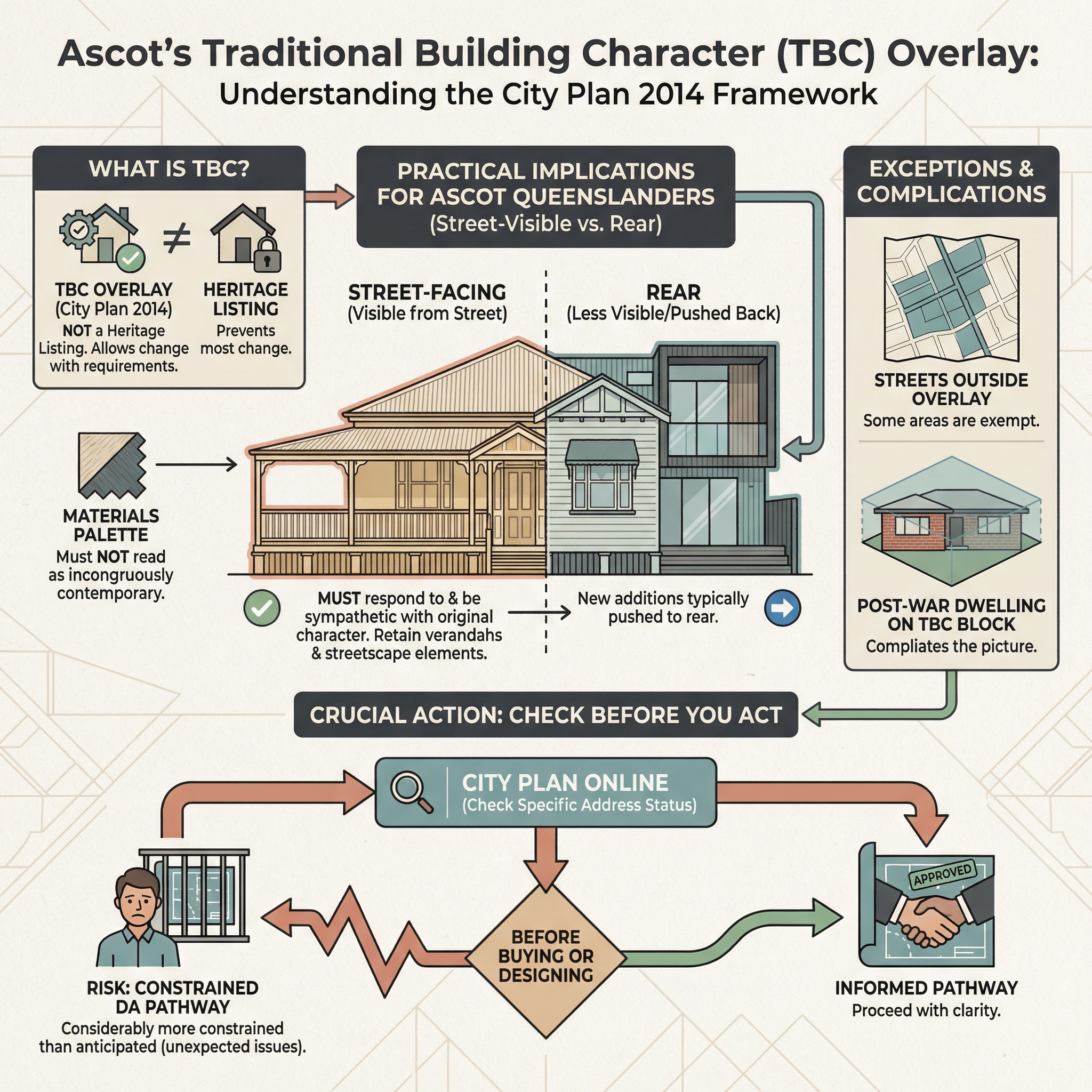
Much of Ascot falls within Brisbane City Council's Traditional Building Character (TBC) overlay under City Plan 2014. This is not the same as a heritage listing — it doesn't prevent all change — but it does impose specific requirements around demolition, street-facing additions, and the treatment of original fabric. Heritage renovation work in Brisbane sits on a spectrum, and Ascot's character homes occupy an important position on it: less tightly constrained than a formally listed heritage place, but far more regulated than a standard suburban renovation.
In practical terms, the TBC overlay means that for most Ascot Queenslanders, any work visible from the street must respond to and be sympathetic with the original home's character. New additions are typically pushed to the rear, original verandahs and streetscape elements are retained, and the materials palette must not read as incongruously contemporary against the existing structure. For this reason, character home renovation in Brisbane — and in Ascot in particular — benefits enormously from working with architects who have direct experience navigating these requirements, rather than those who are encountering them for the first time on your project.
There are streets in Ascot that sit outside the TBC overlay, and blocks where the overlay applies to the street address but the existing dwelling is a post-war replacement that complicates the picture. Checking the overlay status of any specific address using City Plan Online before you buy — or at the very latest before you design — is essential. We've worked with clients who've purchased in good faith only to find the DA pathway considerably more constrained than anticipated.
Flood, Overland Flow, and Aircraft Noise
Ascot is largely flood-free from both Brisbane River and creek flooding — a significant advantage over some nearby suburbs. However, pockets of the suburb, particularly toward the eastern side near Nudgee Road, do carry overland flow mapping that affects what can be built at ground level. Individual lot reports from Brisbane City Council are the only reliable way to confirm this for a specific address.
Homes on the eastern side of Nudgee Road also fall within the aircraft noise overlay. Since the second runway at Brisbane Airport became operational, this has been a more significant consideration. For high-specification homes — particularly those targeting acoustic comfort, home cinema, or quiet outdoor entertaining — the noise overlay is worth factoring into both your site selection and your design brief.
The Architecture of Ascot: What You're Working With
The Ascot Queenslander
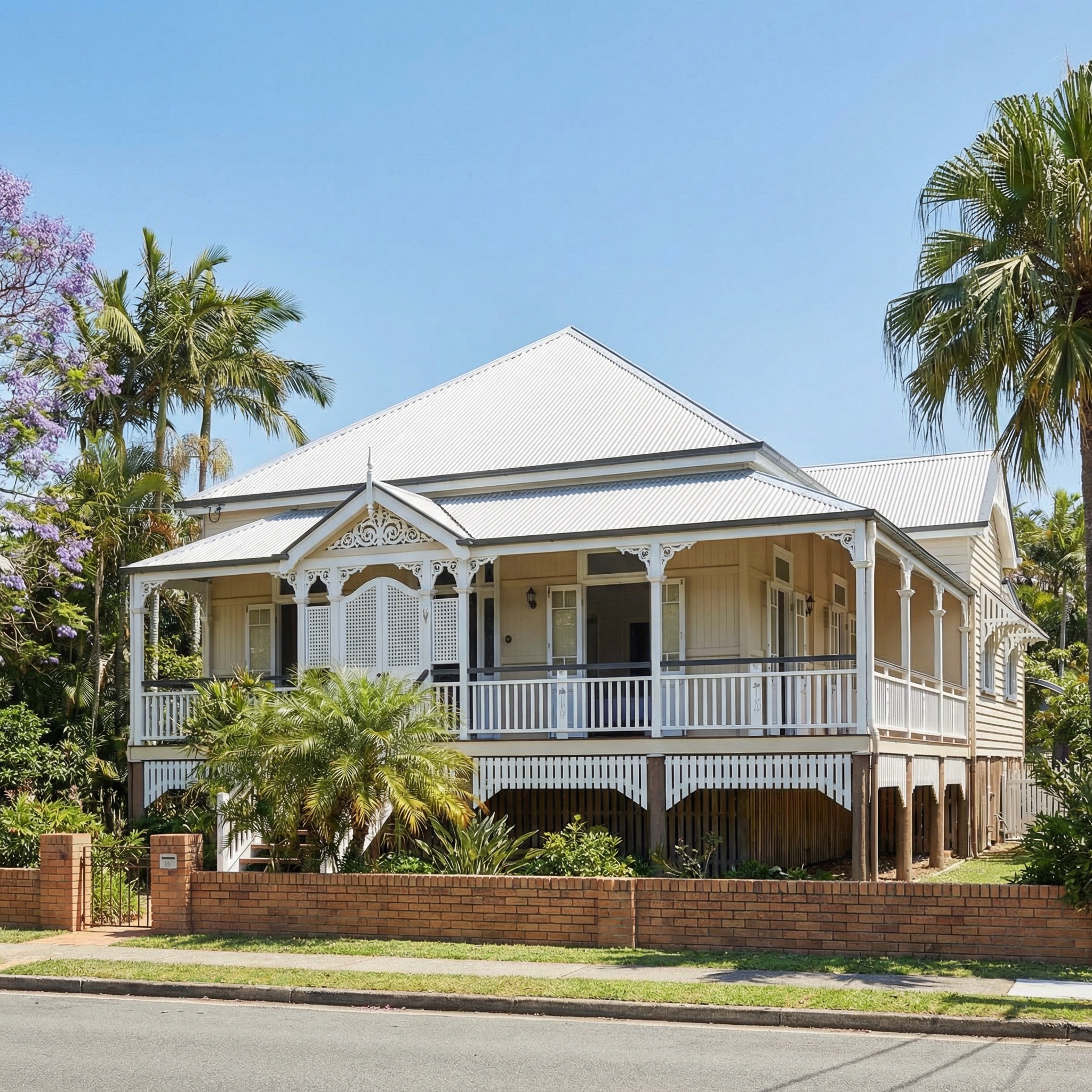
The defining residential form in Ascot is the elevated Queenslander — typically a pre-1946 timber home on stumps, with a high-pitched corrugated iron or terracotta tile roof, VJ-lined interiors, wide verandahs on the street-facing elevations, and ornamental timber detailing to the balustrading, fretwork and fascias. These homes were designed to perform in Brisbane's subtropical climate: the elevation catches breezes, the wide eaves shade the walls, and the verandah acts as a transitional zone between inside and out.
What they were not designed for is the contemporary family brief: open-plan living, double garaging, parent retreats, home offices, or the kind of kitchen and bathroom specification that today's prestige clients expect. The tension between what these homes are and what clients need them to be is the fundamental design challenge of a Queenslander renovation in Brisbane — and in Ascot, where the homes are often large and the expectations are high, getting that tension right demands a skilled Queenslander renovation architect with a clear methodology.
The best Queenslander renovations in Ascot don't try to hide the addition — they create a dialogue between old and new that makes both more interesting.
Renovation Approaches That Work Here

The most successful Ascot renovations we see — and those that hold their value best — tend to follow a consistent logic: the original home is restored and celebrated at the front, a clearly articulated new structure is added at the rear, and the connection between the two is a carefully considered transition zone. This might be a glazed link, a void, a change in ceiling height, or simply a shift in materials. As a renovation architect working in Brisbane, this negotiation between the original fabric and the new addition is where the most interesting design work happens.
What doesn't work — and what council tends to resist — is additions that try to mimic the original home's style at the rear in a way that reads as pastiche, or additions that are so aggressively contemporary that they overwhelm the original from the street. The TBC overlay effectively rules out both extremes.
For the raise-and-build-under option — taking a timber Queenslander off its stumps, raising it, and building a full lower level in masonry — Ascot is a suitable suburb but requires careful structural engineering given the scale of the homes. The additional level typically delivers the extra bedrooms, storage, and garage space the original floor plan can't accommodate.
New Builds in Ascot
Not every Ascot block has a character home on it. Some carry post-war brick dwellings or 1980s houses that fall outside TBC protection and represent a genuine opportunity for a bespoke new home on a well-established, large allotment. Post-war home renovation in Brisbane and 1980s house renovation projects are increasingly common in Ascot as these properties age and their owners look to either transform them significantly or replace them altogether. These sites are among the most sought-after in the suburb for that reason.
For new builds on non-overlay blocks, the design freedom is significantly greater — but the expectations of the streetscape and community remain. Ascot homeowners are invested in their suburb's character, and a new dwelling that reads as entirely alien to its context will attract community and council scrutiny during DA.
The most successful new homes we work on in this corridor take cues from the established typology — generous setbacks, a relationship to the street, mature landscaping, and a roof form that doesn't fight the neighbours — while delivering an entirely contemporary interior and amenity package. A contemporary home architect in Brisbane working at this level brings both a literacy in the local vernacular and the design skill to transcend it. Subtropical modernism, in the vein of what Shaun Lockyer and Joe Adsett have championed, is well-suited here, and the luxury home architect briefs we receive in Ascot consistently reach for that standard.
The Ascot Building Brief: What Clients Are Actually Asking For
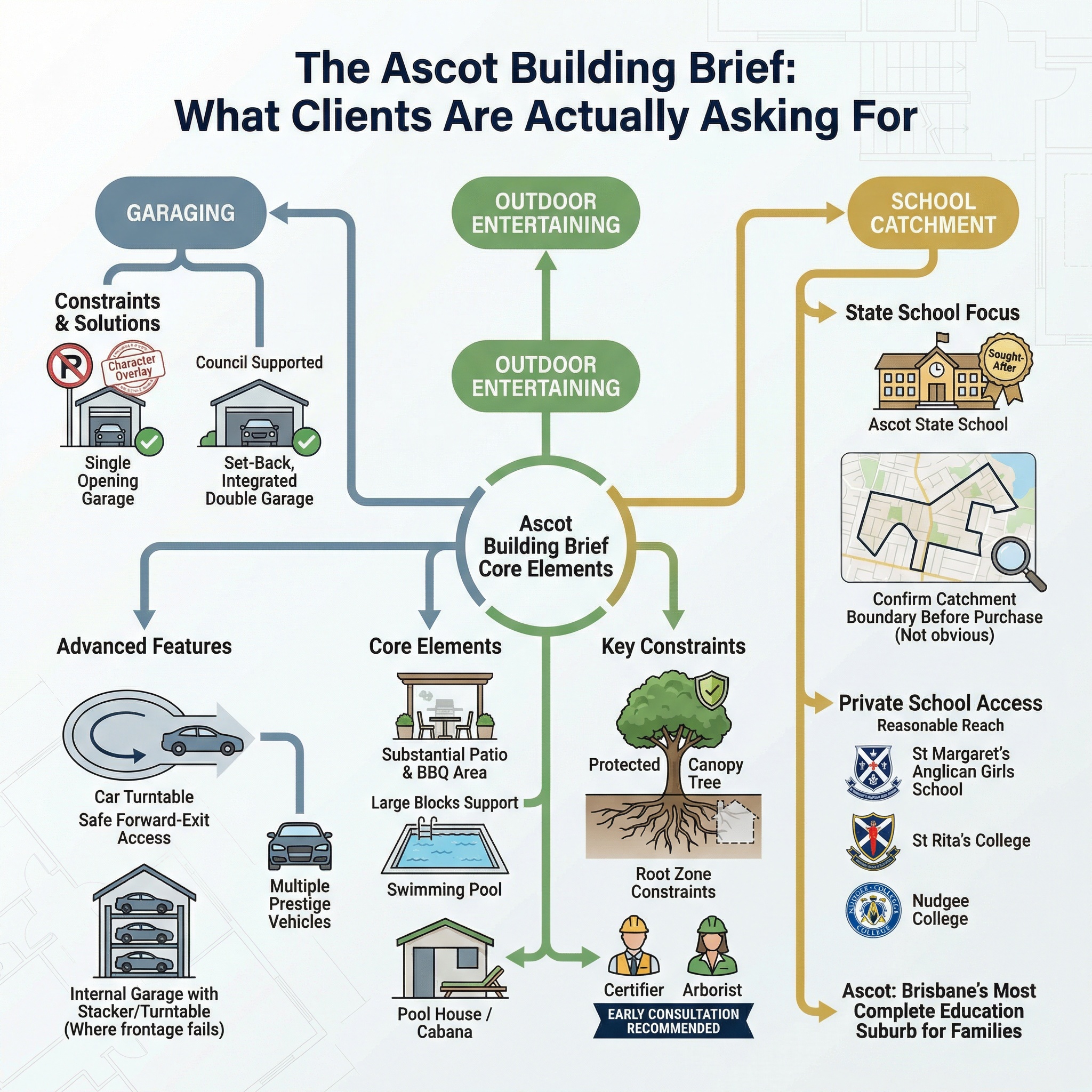
Across the projects we handle in Ascot and the neighbouring prestige suburbs, a few brief elements come up consistently:
Garaging
Ascot's character overlay imposes constraints on garage width at the street frontage. A single garage opening — or a double that is set well back and integrated sympathetically — is typically what council will support on a character overlay block. Clients with multiple prestige vehicles need to work through this carefully at concept stage.
Car turntables are increasingly common on Ascot sites, particularly where the driveway configuration makes safe reversing onto the street problematic or where clients simply prefer the elegance of forward-exit access. Where a full-width double garage isn't achievable at the frontage, a single opening that leads to a larger internal garage — with a turntable or stacker — is often the resolution.
Outdoor Entertaining
The Ascot brief almost invariably includes a substantial outdoor entertaining area, pool, and — increasingly — pool house or cabana. The large blocks support this, but the canopy trees that contribute to the suburb's character are legally protected in many cases, and their root zones impose constraints on where structures can sit. Early consultation with a certifier and arborist is worth the investment.
School Catchment
Ascot State School is one of Brisbane's most sought-after state school catchments — families have been known to camp outside the school on enrolment day. Not all Ascot addresses fall within catchment, and this is a detail worth confirming before purchase if education access is part of the brief. The catchment boundary cuts through the suburb and doesn't always follow obvious street-level logic.
Private school access is also strong — St Margaret's Anglican Girls School, St Rita's College, and Nudgee College are all within reasonable reach — making Ascot one of Brisbane's most complete education suburbs for families.
Streets Worth Knowing in Ascot
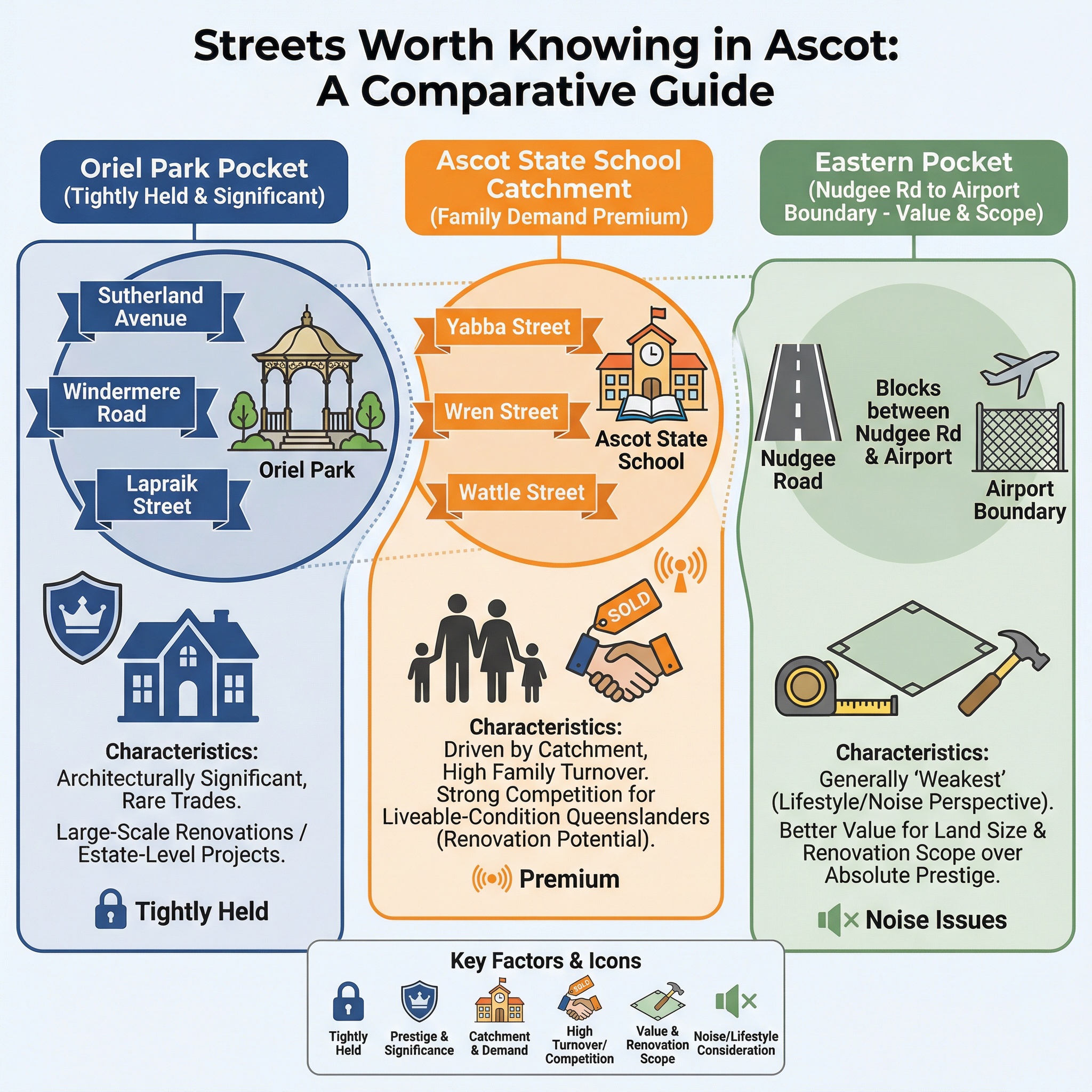
Within Ascot, there are meaningful differences between pockets. The streets around Oriel Park — Sutherland Avenue, Windermere Road, Lapraik Street — are among the most tightly held and architecturally significant. Properties here rarely trade, and when they do, they tend to be large-scale renovations or estate-level projects.
The streets closest to Ascot State School carry a premium driven by catchment demand. Yabba Street, Wren Street, and Wattle Street see high family turnover and strong competition for liveable-condition Queenslanders that can be renovated.
The eastern pocket between Nudgee Road and the airport boundary is generally considered the weakest part of the suburb from a lifestyle and noise perspective — though the blocks can represent better value for clients whose priorities are land size and renovation scope over absolute prestige positioning.
What a Project in Ascot Typically Involves
For context on what serious architecture in Ascot looks like from a process and cost perspective:
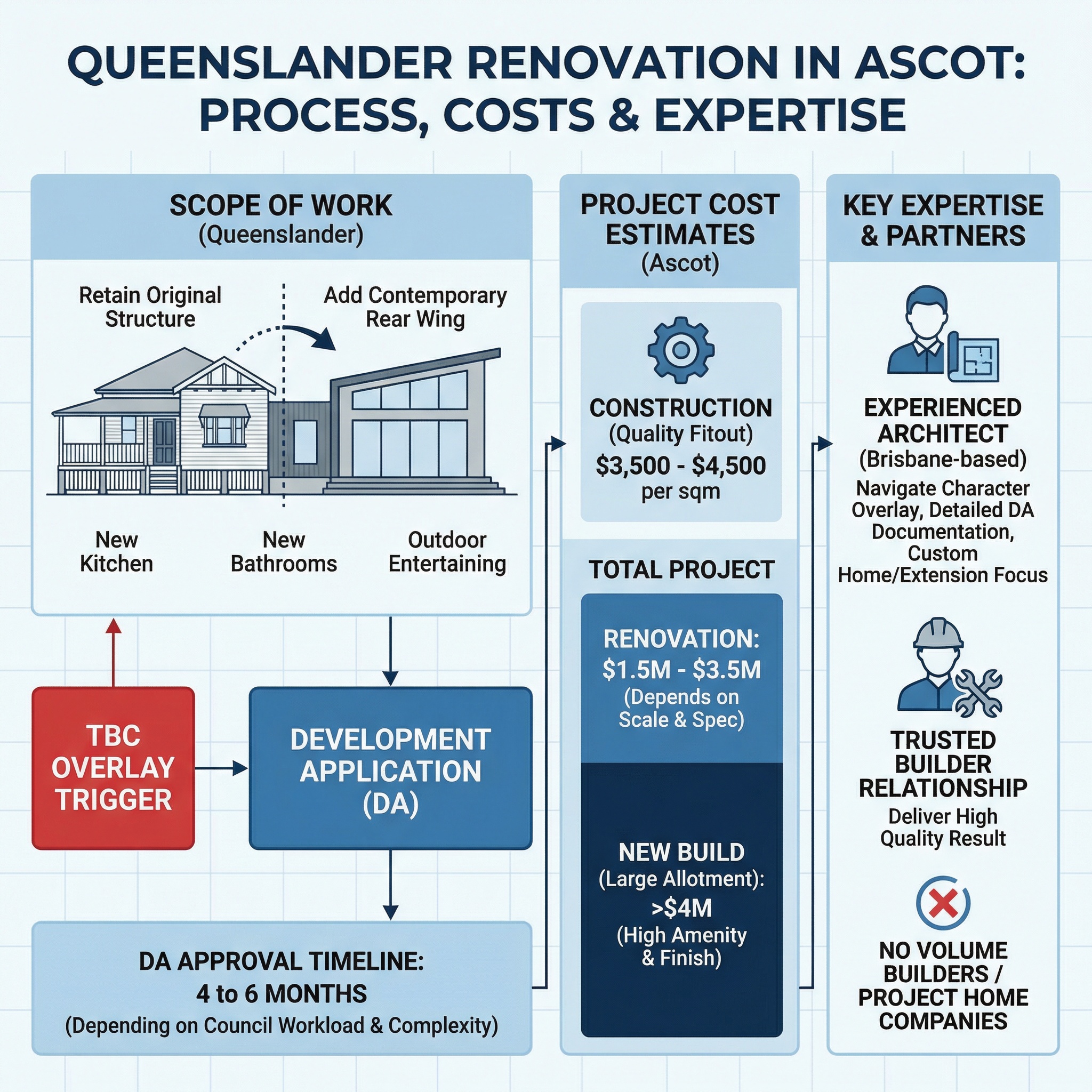
A significant Queenslander renovation — retaining the original structure, adding a contemporary rear wing, new kitchen, bathrooms, and outdoor entertaining — will typically involve a development application given the TBC overlay. Budget at least four to six months for DA approval, depending on council workload and the complexity of the proposal.
Construction costs in Ascot for this category of work currently start from around $3,500 to $4,500 per square metre for quality fitout, with the total project typically in the $1.5 million to $3.5 million range depending on scale and specification. For new builds on large allotments, total project costs can extend well above $4 million for the level of amenity and finish that the suburb commands.
These are not builds suited to volume builders or project home companies. The planning complexity, material specification, and the expectations of the Ascot market require an experienced house extension architect or custom home architect in Brisbane — someone who has navigated the character overlay, produced detailed documentation for DA, and has a trusted builder relationship capable of delivering the result.
The clients who get the best outcomes in Ascot are the ones who start the conversation with their architect before they finalise the land purchase — not after.
Working with Quorum Studios on an Ascot Project
We're a boutique architecture studio based in Newstead, Brisbane, so Ascot is a suburb we work in and understand well. As luxury residential architects, we bring direct experience with Brisbane City Council's character overlay requirements, strong relationships with town planners and certifiers who know this precinct, and a design approach that respects what Ascot is while delivering homes that work for how our clients actually live. Our work has been recognised in the HIA and Master Builders award programmes, and we're one of a small number of practices in Brisbane whose principals are actively involved in industry judging — which means we stay close to the standard of work being produced across the market.
If you're looking for architects in Ascot, Brisbane, we'd encourage you to look at the full picture: not just the rendered images on a website, but the planning track record, the builder relationships, and the principal's direct involvement in your project. That's what we offer, and it's what a project of this scale deserves.
Our process starts with a thorough site and planning assessment before a line is drawn — which means our clients understand what's achievable, what the approval pathway looks like, and what a realistic project cost is before they commit to design fees.
----------------------------------------------------------------------------------------------------------------------------------------------------------------------------------
Quorum Studios is a boutique residential architecture practice based in Newstead, Brisbane. We work as bespoke residential architects and custom home architects across Brisbane, the Gold Coast, and the Sunshine Coast, specialising in high-end new homes, Queenslander renovations, and character home renovations. Construction budgets from $1.5M.
Disclaimer: The content in this article reflects our professional opinions and general observations as architects practising in Brisbane. Planning overlays, council requirements, construction costs, and market conditions change regularly. All information should be independently verified with the relevant authorities — including Brisbane City Council, a registered town planner, and other qualified consultants — before making any significant property or design decisions. Nothing in this article constitutes formal planning, legal, or financial advice.

Ready to begin your home design journey?
Request a Consultation